 Select Language
 English
 Spanish
 Polish
 Japanese
 Italian
 French
Drainage or Volume? A One-Stop PET Bottles Recycling Solution for Recyclers
Water bottles and most beverage bottles are made from PET, and the idea that “PET bottles are recyclable” is widely recognized. Recycled PET (rPET) can be used in higher-value products such as recycled packaging, food-grade trays, and textile fibers.
After consumption, many PET bottles end up in trash bins and are later collected by recyclers. Some beverage manufacturers also outsource the handling of expired products or bottles with printing defects. For upstream recyclers, the key challenge is how to quickly turn mixed bottles—often with a lot of leftover liquid—into recyclable material that downstream buyers will accept, and monetize it as soon as possible.
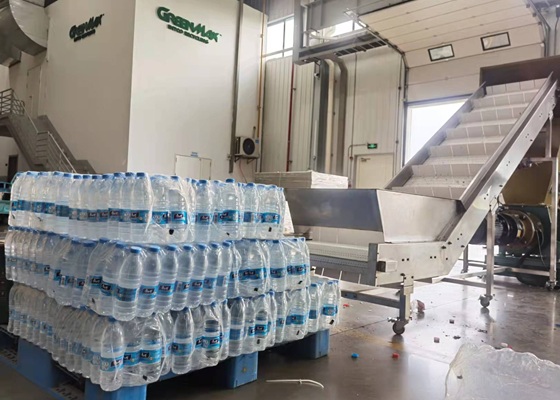
The real headache is often not “whether recycling channels exist,” but that newly discarded bottles frequently contain significant residual liquid (water, soda, juice, dairy drinks, etc.). Manual draining is slow and messy. Meanwhile, shipping large volumes of loose bottles to downstream pelletizers is expensive and increases operational pressure. To make downstream buyers more willing to take the material—and to speed up revenue recovery—you need to convert “wet, loose bottles” into clean, consistent, transport-friendly recyclable feedstock. In other words, solve PET bottle drainage and “full-bottle” compaction.
· Efficient drainage/dewatering: Use a plastic dewatering machine to separate liquid from packaging, reducing leakage, odors, and weight while making onsite handling easier.
· Higher density / volume reduction: Use a plastic bottle baler to compress loose bottles into dense bales, cutting transportation costs and making receiving and weighing easier for downstream processors.
A one-stop PET bottles recycling path (from waste bottles to deliverable feedstock):
Collection & sorting → Drainage/dewatering → High-density compaction → Bale for shipment / Send to washing & pelletizing
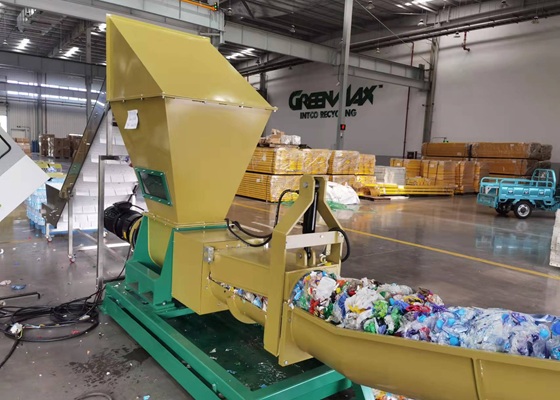
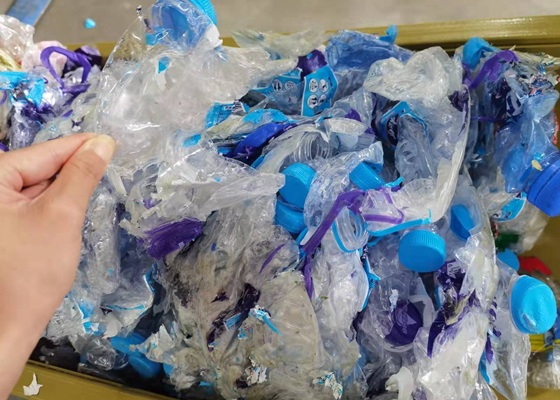
1) Screw-Type PET Bottle Compactor: GreenMax Plastic Dewatering Machine P-C350
This unit is designed to solve the core issue of “bottles with water or leftover beverages inside,” and it can achieve about 10:1 volume reduction.
With continuous screw compression, the machine separates and collects the liquid while compacting the bottles to increase density and reduce volume—lowering storage and transportation pressure. The separated liquid flows into a collection tray and is routed via connected piping to a designated discharge area. Depending on local regulations and site needs, the liquid may also be reused (for example, irrigation or as livestock feed input).
The P-C350 focuses on PET beverage bottle drainage and volume reduction—“liquid separation + volume reduction.” After processing, bottle moisture content can be reduced to below 10%, keeping the workplace cleaner and easier to manage. The plastic dewatering machine can also process other beverage packaging such as aluminum cans, Tetra Pak cartons, and yogurt cups.
2) Vertical Plastic Bottle Baler
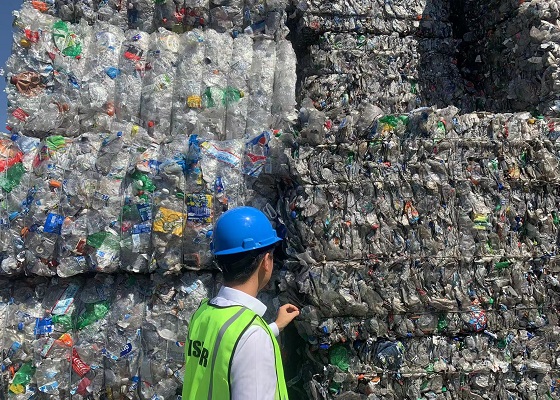
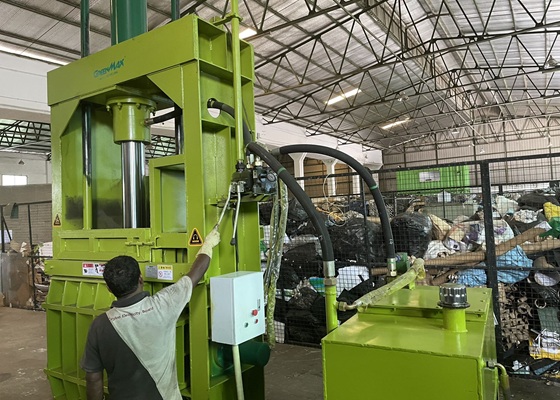
After the GREENMAX PET bottle compactor P-C350 completes drainage/dewatering, a baler is used to turn PET bottles from loose material into deliverable, sellable bales. This step often has a direct impact on the selling price of compacted bales.
The baler uses hydraulic compression to form high-density bales, secured with wire or strapping. A single bale can weigh 300–500 kg. This improves truck loading density, lowers freight costs, and saves storage space. Bale size is more consistent and weight is easier to measure, which helps with receiving and settlement with downstream washing plants and pelletizers.
If you want higher bale purity and consistency—and better pricing—you can add a label remover (de-labeling machine) before baling to remove label contamination and improve washing and pelletizing efficiency. This creates a more complete, one-stop PET bottles recycling line.
Recommended setup: Use a plastic dewatering machine upfront to address “wet bottles + volume reduction,” then a plastic bottle baler for high-density baling—delivering transport-ready, tradable bales/feedstock.
Case References
Case 1: Nonconforming/Expired Bottles at a Nestlé Facility
The GREENMAX PET bottle compactor P-C350 was used for batch processing of nonconforming bottled water, separating residual liquid and compacting volume. Reportedly, dewatering efficiency improved by about 200×, reducing manual draining costs to roughly 1/200.
Case 2: Building a PET Bottles Recycling Chain in Africa (DRC)
GREENMAX supported Phoenix Techno Concept Multi Crate Sarl in Kinshasa on a PET bottles recycling project, deploying a label remover and a baler (among other equipment) to convert loose bottles more efficiently into transportable, tradable recyclables.