 Select Language
 English
 Spanish
 Polish
 Japanese
 Italian
 French
UK Recycling Company Uses GREENMAX A-C200 for EPS Recycling
A UK recycling company is using GREENMAX EPS compactor A-C200 to process expanded polystyrene collected through its recycling operations. The machine reduces loose EPS foam volume by up to 50:1, turning bulky material into dense blocks that are easier to store, handle and transport.
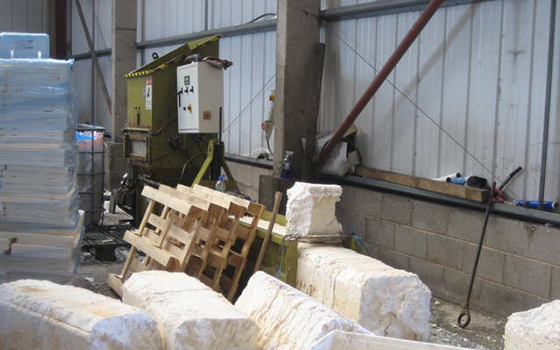
The GREENMAX EPS compactor uses cold compaction rather than heat. EPS is first crushed into smaller pieces and then pressed into continuous blocks by a screw compression system. This process retains the material’s polystyrene structure while greatly reducing the space it occupies.
The equipment can process EPS packaging as well as selected XPS and foamed polystyrene sheet materials. For this UK recycler, the main application is EPS waste collected from commercial sources. Once compacted, the blocks can be transported in larger quantities and supplied to a downstream recycling company for further processing.
By using GREENMAX EPS compactor A-C200, the company has made its EPS recycling operation more manageable. Loose foam requires less storage space after compaction, while denser loads make transportation more practical.
The compacted EPS can later be processed into recycled polystyrene material and used to manufacture new plastic products. This UK case shows how an EPS compactor can connect foam collection with downstream recycling without adding a thermal melting stage.
FAQ
1. How much can the GREENMAX A-C200 reduce EPS volume?
The A-C200 can reduce loose EPS foam volume by up to 50:1. Actual results depend on the density and condition of the incoming material.
2. Does the A-C200 use heat to compact EPS?
No. It uses crushing and mechanical screw compression to form dense blocks without melting the EPS.
3. What happens to EPS after compaction?
The compacted blocks can be transported to a downstream recycler, where the polystyrene is processed into recycled raw material for new plastic products.
CASES
-
VIP Partner
-
EUROPE
- Netherlands
- Slovakia
- Belgium
- France
- Italy
- Poland
- Spain
- UK
- France
- Ireland
- C.T.C
- Hirsch Isolation
- Hungary
- Czech
- Germany
- Forcepol Sl
- ALBATERM
- Serbia
- PMT
- Telcam
- Muijs Seafood
- TBK
- Qualirec
- Britain
- PRO EPP
- ECOTEC Sàrl
- SOPREMA Tecsound
- GRUPPO YU SRL
- Airpol Italia
- Ados Sarl
- Poliembalajes
- Tecno Profili
- RGH
- Iberfibran
-
OCEANIA
-
AFRICA
-
SOUTH AMERICA
-
NORTH AMERICA
-
ASIA