 Select Language
 English
 Spanish
 Polish
 Japanese
 Italian
 French
Czech recycling company uses GREENMAX foam compactor to process EPS and EPP waste.
As Europe continues to advance its circular economy and environmental regulations, the recycling and treatment of industrial foam packaging waste is receiving increasing attention. In particular, EPP foam, which is widely used in automotive parts packaging and industrial reusable packaging, is becoming a new focus in the recycling industry due to its strong toughness, high density, and high recycling value. Compared with traditional EPS foam, EPP foam recycling places higher requirements on equipment in terms of crushing capacity, compression stability, and block-forming performance, prompting recycling companies to seek more professional processing solutions.
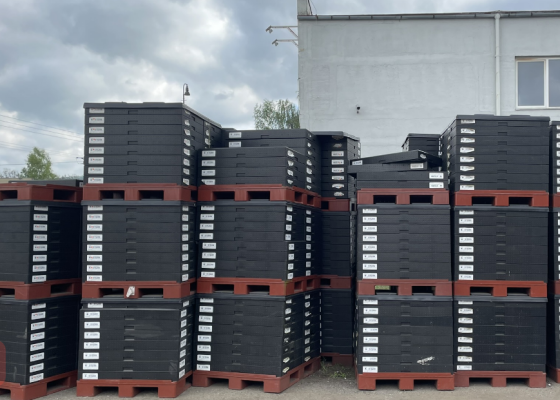
A well-known recycling company in the Czech Republic is a professional local waste management enterprise. Together with its sister company, it belongs to a local waste management group and has long served domestic manufacturing companies. Its business covers plastic waste treatment, metal waste treatment, harmless disposal of hazardous waste, and energy recovery. The company holds ISO 9001, ISO 14001, and ISO 45001 certifications, and is also a member of the Czech Waste Management Association, demonstrating mature experience in the industrial waste treatment sector.
Before the cooperation, the company needed to process approximately 20 tons of industrial foam waste per month, including 10 tons of EPS packaging waste from the home appliance industry and 10 tons of EPP packaging waste from the automotive parts industry. The EPP materials were loaded on European standard pallets, with a maximum size of 60×80 cm and a typical density of 40–70 kg/m³. Due to its more compact structure and stronger resilience, untreated EPP foam not only occupies a large amount of storage space but also increases transportation and management costs. At the same time, traditional treatment methods such as landfilling and incineration are costly and increasingly unable to meet Europe’s stricter environmental requirements. For the customer, how to turn low-value, loose foam waste into sellable and marketable recycled resources became the key to improving business value.
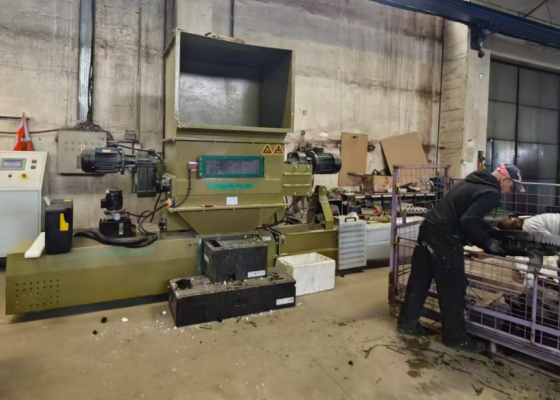
During the equipment selection stage, the customer compared screw compaction equipment with foam compactor. Considering the demand of the European recycled material market, the characteristics of the materials, and long-term operating costs, GREENMAX finally recommended the foam compactor Z-C200 to the customer. Compared with hot-melted material, cold-compacted EPS and EPP foam blocks have better market circulation in Europe and are more convenient for downstream companies to sort, transport, and reprocess. Meanwhile, the screw compaction process consumes less energy and offers stronger operational stability, making it suitable for recycling companies that need to process industrial foam waste continuously over the long term.
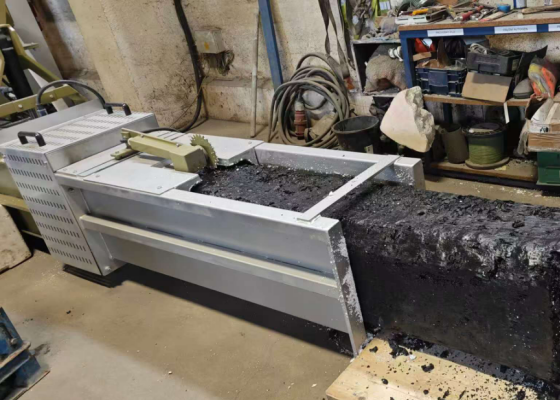
To meet the customer’s need to process both EPS and EPP materials, GREENMAX made targeted optimizations to the Z-C200 model. The crushing unit is equipped with two reinforced 5.5 kW motors, which can effectively handle high-density EPP materials of 40–70 kg/m³. The main screw is equipped with a variable frequency speed control system, allowing the rotation speed to be flexibly adjusted according to different foam characteristics. When processing lightweight EPS, the equipment can maintain stable feeding and uniform block formation. When processing rigid EPP, the parameters can be adjusted to improve the compactness and continuity of the compressed blocks. Therefore, this equipment is not only an efficient EPS foam compactor, but also a customized solution suitable for EPP foam recycling.
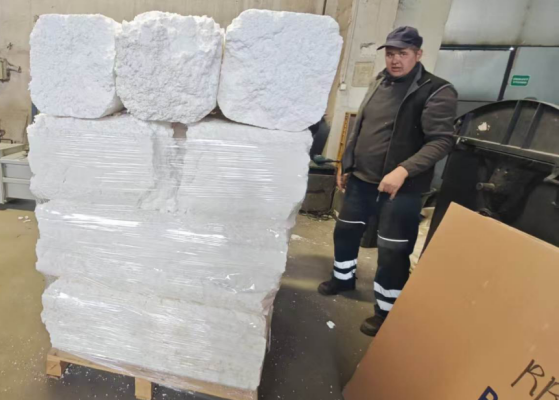
After installation and remote commissioning, the company has been able to stably process approximately 20 tons of EPS and EPP foam waste per month. After crushing and screw compaction, the bulky and difficult-to-transport foam waste is processed into compact and uniform blocks, greatly reducing storage and logistics pressure while improving the recycling value of the waste materials. In particular, after volume reduction, EPP foam can more smoothly enter the downstream recycling chain, helping the customer transform industrial waste treatment into a more profitable resource recycling business.
With the increasing use of EPP materials in the automotive, home appliance, and logistics packaging industries, the volume of EPP foam waste is expected to continue growing in the future. Driven by European environmental policies and the circular economy, EPP foam recycling will receive growing attention from manufacturers, waste management companies, and recycled resource enterprises. The cooperation between this Czech recycling company and GREENMAX is a typical example of transforming EPS and EPP industrial foam waste into high-value recycled raw materials, and also provides a practical reference for more local recycling projects in Europe.
FAQ
1. What types of foam can this recycling solution handle?
The system is designed to process both EPS and EPP foam, including packaging waste from home appliance and automotive industries.
2. What are the benefits of using a compaction system for foam waste?
It significantly reduces storage volume and transportation costs while turning loose foam waste into compact blocks that are easier to sell and recycle.
3. Is the processed foam material suitable for resale?
Yes, the compacted EPS and EPP blocks can enter the recycling market and be reused as raw materials for further processing.
CASES
-
VIP Partner
-
EUROPE
- Netherlands
- Slovakia
- Belgium
- France
- Italy
- Poland
- Spain
- UK
- France
- Ireland
- C.T.C
- Hirsch Isolation
- Hungary
- Czech
- Germany
- Forcepol Sl
- ALBATERM
- Serbia
- PMT
- Telcam
- Muijs Seafood
- TBK
- Qualirec
- Britain
- PRO EPP
- ECOTEC Sàrl
- SOPREMA Tecsound
- GRUPPO YU SRL
- Airpol Italia
- Ados Sarl
- Poliembalajes
- Tecno Profili
- RGH
- Iberfibran
-
OCEANIA
-
AFRICA
-
SOUTH AMERICA
-
NORTH AMERICA
-
ASIA