 Select Language
 English
 Spanish
 Polish
 Japanese
 Italian
 French
GREENMAX Helps a Foam Packaging Company Improve Foam Recycling Efficiency
In the German and broader European packaging industry, foam recycling is becoming an important way for companies to reduce waste disposal costs and improve resource utilization. Foam materials such as EPE, EPP, and EPS are bulky and low in density. Without effective compaction and recycling, they not only take up valuable storage space but also increase transportation and disposal costs. As a result, more packaging companies are looking for efficient and stable foam recycling solutions.
Stephan Schaumstoffe GmbH is a foam packaging company based in Germany. Its business mainly serves the local German market, while also covering some customers in Austria and Italy. Due to the high transportation cost of foam packaging materials, the company tends to serve customers within a reasonable distance in order to reduce the cost of “transporting air.” At present, the customer’s business remains stable and continues to grow gradually.
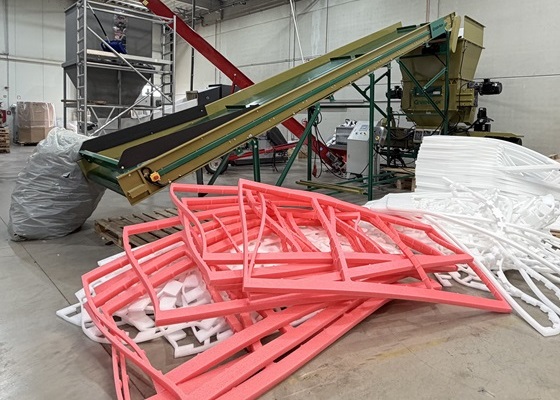
The customer mainly processes EPE, EPP, EPS, and other foam packaging waste. Its end customers are involved in industries such as medical, electronics, and solar energy. Among them, medical industry customers account for a relatively high proportion, while some electronics and solar energy customers also generate a considerable amount of foam waste during production and packaging. For customers with large volumes of waste, Stephan Schaumstoffe GmbH provides free waste treatment services, helping them reduce disposal costs while securing a stable waste source. For companies with smaller waste volumes, centralized collection and processing by Stephan Schaumstoffe GmbH is a more economical solution than investing in their own foam recycling machine.
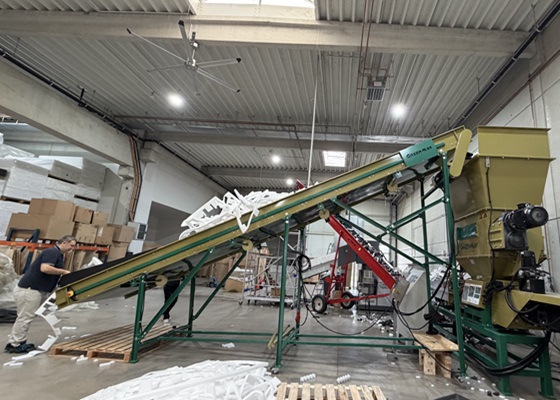
To improve processing efficiency, the customer introduced the GREENMAX foam recycling machine Z-C200 to handle various types of foam packaging waste. After the equipment was put into operation, the customer was able to process around 30 tons of foam waste per month, making the machine an important part of its daily recycling business.
According to the customer’s feedback, GREENMAX foam recycling machine Z-C200 operates stably overall and performs especially well in reducing labor costs. In the past, the production line might have required two shifts with a total of four workers. Now, only one worker is needed to operate the entire production line, significantly lowering labor costs and improving overall processing efficiency.
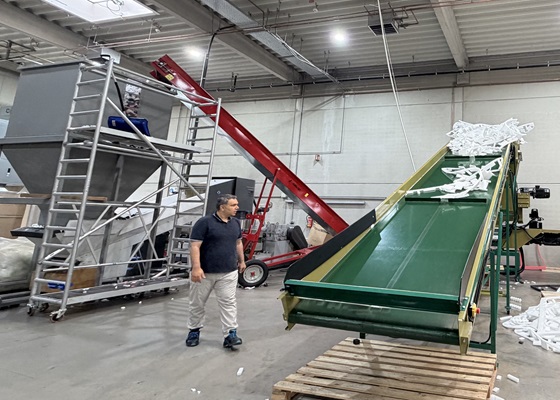
During the customer visit on May 8, 2026, the customer mainly discussed issues related to feeding methods and parameter settings. Since the customer processes many types of foam materials, different materials vary in density, hardness, softness, and temperature. If too much material is fed into the machine at one time, problems such as blockage, excessive pressure, or abnormal noise may occur. After communication, the GREENMAX team suggested that the customer feed 1–2 pieces of material each time and adjust the feeding speed and related parameters according to the characteristics of the material. If the equipment runs for 8–10 hours per day, this method can generally meet the customer’s daily production needs.
This case also shows that the stable operation of foam recycling machine depends not only on machine performance, but also on proper feeding methods and parameter adjustment. For harder materials, the feeding speed should be appropriately reduced to avoid excessive pressure. For softer or warmer materials, mixed feeding can help improve processing stability. Therefore, during equipment delivery and customer training, it is important to provide operation guidance based on the customer’s actual materials, helping them reduce blockages and abnormal conditions.
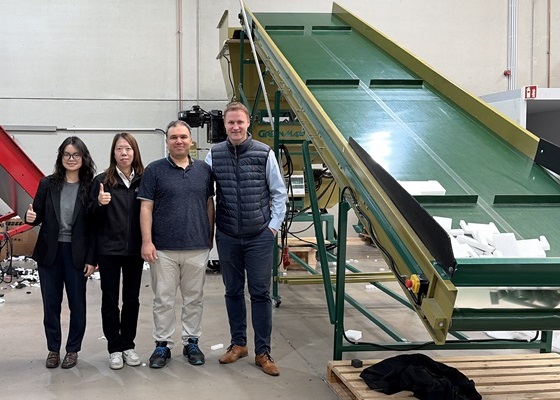
From a market perspective, Germany and the European market are continuing to promote the application of recycled materials in the packaging industry. With the development of environmental regulations and policies such as PPWR, the demand for foam recycling is expected to further increase. The customer believes that compared with some European equipment suppliers, GREENMAX has advantages in response speed, pricing, and equipment suitability. The after-sales team is also able to provide timely support for parameter adjustment and operation optimization.
At present, the customer has given positive feedback on GREENMAX equipment and service. They also expressed willingness to provide a reference for future European customers, as long as there is no direct competition, and to share their actual experience with GREENMAX foam recycling machine.
In the future, GREENMAX will continue to focus on packaging waste treatment needs in industries such as medical, electronics, and solar energy. Through efficient and stable GREENMAX foam recycling solutions, GREENMAX aims to help more European customers reduce waste handling costs and improve the value of resource recycling.
FAQ
1. What types of foam can be recycled with a foam recycling machine?
Common materials include EPS, EPE, EPP, and other foam packaging waste generated during manufacturing and distribution.
2. Why do packaging companies recycle foam waste?
Recycling helps reduce storage space, transportation costs, and waste disposal expenses while improving resource utilization.
CASES
-
VIP Partner
-
EUROPE
- Netherlands
- Slovakia
- Belgium
- France
- Italy
- Poland
- Spain
- UK
- France
- Ireland
- C.T.C
- Hirsch Isolation
- Hungary
- Czech
- Germany
- Forcepol Sl
- ALBATERM
- Serbia
- PMT
- Telcam
- Muijs Seafood
- TBK
- Qualirec
- Britain
- PRO EPP
- ECOTEC Sàrl
- SOPREMA Tecsound
- GRUPPO YU SRL
- Airpol Italia
- Ados Sarl
- Poliembalajes
- Tecno Profili
- RGH
- Iberfibran
-
OCEANIA
-
AFRICA
-
SOUTH AMERICA
-
NORTH AMERICA
-
ASIA