 Select Language
 English
 Spanish
 Polish
 Japanese
 Italian
 French
GREENMAX Foam Hydraulic Compactor Helps Shanghai Blue Whale Resources Improve EPS Recycling Efficiency
As urban waste sorting and resource recycling systems continue to improve, the efficient handling of EPS foam waste has become an important part of daily operations for recycling enterprises. Shanghai Blue Whale Resources Recycling Technology Co., Ltd., located in Putuo District, Shanghai, has long been involved in local recyclable material collection, transfer, disposal, and waste sorting support services. As a regional recycling company serving the “two-network integration” system, Blue Whale Resources needs practical solutions to improve the efficiency of recyclable material processing.
EPS foam is widely used in home appliances, furniture, cold chain logistics, packaging, and transportation industries because of its excellent cushioning and protective performance. However, discarded EPS foam has a large volume and low density. If it is stored or transported without treatment, it takes up significant space, increases vehicle trips, and raises labor and logistics costs. For a company like Blue Whale Resources, which is responsible for urban recycling and transfer operations, reducing the volume of loose foam waste is a key challenge.
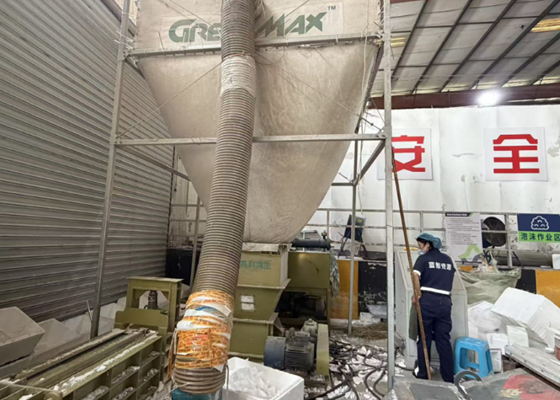
In 2019, Blue Whale Resources first cooperated with GREENMAX and purchased an A-C100 foam compactor to process EPS foam waste collected through its daily recycling system. After the equipment was put into operation, it helped the customer reduce foam storage pressure and improve transportation efficiency. As the customer’s business volume continued to grow, higher requirements were placed on processing capacity and compression performance. In 2022, Blue Whale Resources chose GREENMAX again and purchased an foam hydraulic compactor H-C300 to further upgrade its EPS foam volume reduction capability.
GREENMAX foam hydraulic compactor H-C300 is mainly used for cold pressing EPS foam. According to on-site operating data, the customer processes approximately 700-800 kg of EPS foam per day. Usually, one operator is responsible for removing tape and running the machine, while another staff member handles equipment maintenance. With a compacted density of around 300 kg/m³ and a capacity of about 200 kg/h, the H-C300 can compress loose EPS foam into regular and dense cold-pressed blocks.Compared with untreated foam, the compressed blocks are much easier to stack, load, transport, and send for further recycling.
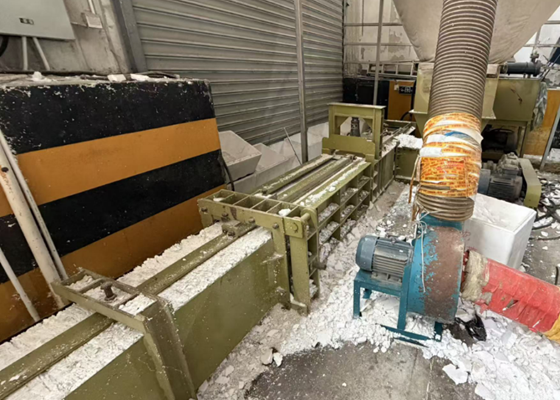
During the customer’s use of the equipment, the GREENMAX after-sales team also provided timely inspection and maintenance support. When abnormal limit signals occurred on site, the service team checked the machine and identified the main causes, including a damaged PLC input point for the front cylinder limit and shifted limit switch positions after replacement. The team adjusted the external PLC wiring, optimized the internal program, and recalibrated the mechanical limit positions. After maintenance, the machine resumed normal operation.
After the equipment was restored, the customer commented that the machine was working well and that the compression result was satisfactory. Based on actual site performance, the foam hydraulic compactor H-C300 meets Blue Whale Resources’ daily EPS foam recycling needs. It helps turn bulky, loose, and low-density foam waste into high-density compressed blocks, reducing storage pressure and improving material transfer efficiency.
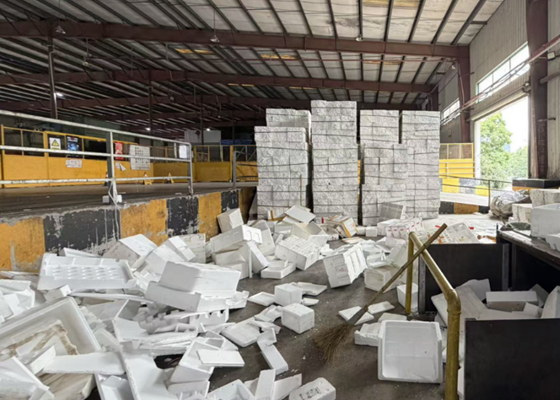
The cooperation with Shanghai Blue Whale Resources shows that GREENMAX foam hydraulic compactor solutions can help recycling companies reduce volume, lower costs, and improve operational efficiency when handling EPS foam waste. For sanitation companies, third-party recycling enterprises, waste sorting service providers, and two-network integration platforms, the GREENMAX H-C300 is not only a foam compaction machine, but also a reliable tool for optimizing site management, improving recyclable material transfer efficiency, and supporting sustainable resource recovery.