 Select Language
 English
 Spanish
 Polish
 Japanese
 Italian
 French
GREENMAX foam densifier J-C50 to Debut at N-EXPO 2026 - Driving EPS Circular Recycling Upgrades in Japan
As Japan continues to advance its goals for resource circulation and carbon reduction, EPS foam recycling is moving beyond simple recyclability toward a new stage defined by higher efficiency, lower-volume reduction costs, and on-site processing. According to data released by the Japan Expanded Polystyrene Association (JEPSA), the effective utilization rate of waste EPS in Japan reached 94.2% in 2024, setting a new record high. This figure shows that Japan has already built a strong foundation for EPS recycling, but it also indicates that the market now requires equipment that can better balance safety, processing efficiency, space utilization, odor control, and downstream transportation convenience.
In response to this market demand, GREENMAX will showcase its latest foam densifier, the J-C50, at N-EXPO 2026 in Tokyo next month. N-EXPO 2026 will be held from May 20 to May 22, 2026, at Tokyo Big Sight, providing local recyclers, logistics companies, supermarkets, electronics retailers, and industrial users with large volumes of foam waste an excellent opportunity to learn more about the machine’s performance and application scenarios up close.
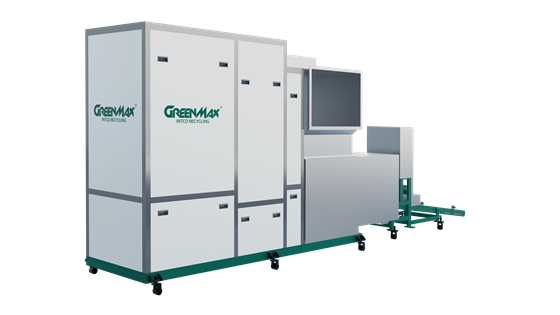
Designed for on-site densification and recycling, the GREENMAX J-C50 adopts an electric heating system and offers highly efficient densification performance. It is especially suitable for users with limited installation space who still need a reliable solution for foam recycling. Compared with conventional recycling methods, this machine can significantly reduce foam volume, lower storage and transportation costs, and make recycling operations easier to carry out directly in retail stores, warehouses, recycling stations, or factories. For the Japanese market, where safety and environmental friendliness are especially valued, the J-C50 provides a clear and practical answer.
First, the J-C50 uses a safer melting system in which the molten material does not come into direct contact with the heater, helping reduce potential operational risks. Its external heating structure also makes maintenance easier, since the heater can be replaced without removing the melting section. In addition, the machine is equipped with a touchscreen control system, fault display function, automatic stop device, and a built-in deodorizing unit, which not only improves operational safety but also enhances user convenience. Since Japanese customers place strong emphasis on workplace cleanliness and odor control, the J-C50’s activated carbon adsorption system for styrene odor generated during melting helps create a cleaner working environment.
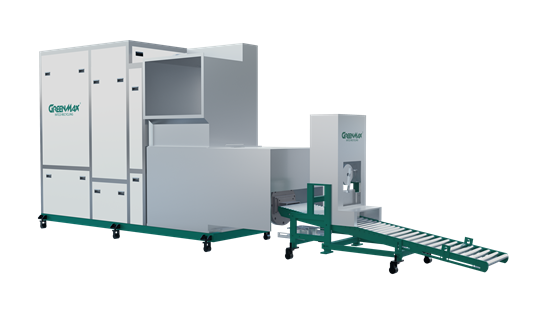
In terms of practical value, the J-C50 does more than simply “make foam smaller.” It helps companies improve the overall quality of their recycling operations. The machine is equipped with a high-precision cutter that cuts melted material into plate-shaped ingots, with sizes adjustable according to customer requirements. These ingots undergo less degradation and are easier to handle and store, making them more suitable for downstream resale and reuse. At the same time, the J-C50 can process a wide range of materials, including EPS expanded polystyrene, PSP foam trays, flame-retardant XPS extruded polystyrene, EPE foam, and EPP foam, which further expands its value in Japan’s diverse recycling scenarios.
From a design perspective, the J-C50 features an integrated electrical control layout that makes the machine more compact and space-saving. Its feeding hopper, crushing chamber, crushing blades, and extrusion screw are all made of stainless steel, providing stronger corrosion resistance. The straight-through structural design also improves the machine’s tolerance to foreign materials. For companies seeking to continue EPS foam compression recycling while keeping labor and maintenance costs under control, the J-C50 delivers a strong balance of efficiency, stability, and long-term value.
As Japan’s EPS recycling rate continues to rise, demand for high-quality volume reduction equipment is expected to grow further. INTCO Recycling’s presentation of the J-C50 foam densifier at N-EXPO Tokyo is not only a product debut, but also a focused step in promoting recycling technology to the Japanese market. For businesses looking to improve recycling efficiency, reduce logistics costs, and optimize on-site operations, the J-C50 is expected to become a highly effective solution in the foam recycling chain.