 Select Language
 English
 Spanish
 Polish
 Japanese
 Italian
 French
How a Paris Recycler Used EPS Compactor to Cut Costs and Boost EPS Recycling Efficiency
In Paris, France, a recycling company has long provided EPS recycling services for its customers. These customers generate large volumes of foam packaging waste every day, and the recycler regularly schedules trucks to collect the material on-site. At the beginning, it was a stable and sustainable partnership. However, as business volume grew, one issue became increasingly obvious—transportation costs were too high, steadily squeezing profit margins.
The typical characteristics of EPS foam are “bulky and lightweight.” This directly leads to extremely low loading efficiency: the truck may look completely full, but the actual weight of material transported is very limited. To keep up with the collection schedule, the recycler had to make frequent trips to the customer site. Fuel costs, labor expenses, and vehicle wear and tear continued to rise. On the surface, there were many trips and a lot of work, but the “effective payload” that truly created value was not high. For this Paris recycler, if they continued using the traditional collection method, the business would not only struggle to increase profits, but could even fall into a trap where the more they grew, the higher their costs became.
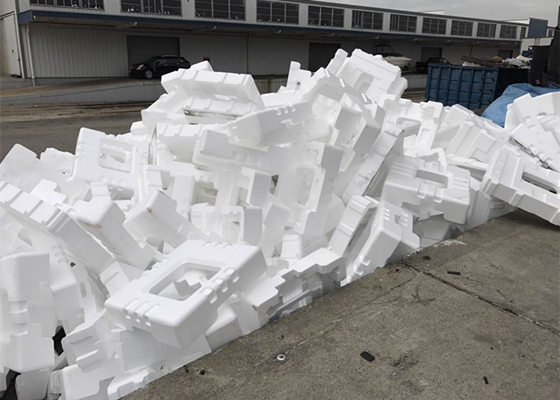
After reviewing their operations, the recycler identified the core problem: uncompacted EPS foam takes up almost all available transport space. A truck can be “full” but still “light,” which inevitably means more trips, higher logistics costs, and shrinking returns. Once cost increases begin to outpace recycling revenue growth, maintaining and expanding the partnership becomes increasingly difficult.
By chance, the recycler learned about the GREENMAX EPS compactor and proactively contacted the GREENMAX team. After discussions and evaluation, they decided to place an EPS compactor directly at the customer’s site, so EPS foam could be densified at the source and processed more efficiently—making EPS recycling truly viable.
After the equipment was installed, the entire recycling workflow changed. EPS waste generated on-site no longer piled up waiting for pickup; instead, it went straight into the EPS compactor. Loose foam was quickly compressed into high-density blocks, dramatically reducing volume. For the customer, foam waste that previously occupied large areas was processed promptly, freeing up storage and operational space and making the site cleaner and more efficient. For the recycler, the collection target shifted from “foam piles full of air” to “stable, dense blocks,” and the transport rhythm changed from frequent pickups to lower-frequency, higher-efficiency shipments.
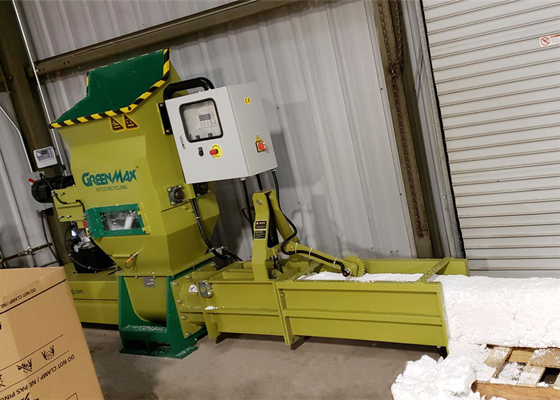
After adopting the GREENMAX EPS compactor A-C200, the compression ratio reached 50:1. EPS volume was significantly reduced, allowing the same truck to carry dozens of times more effective material per trip. Transport frequency dropped sharply, and fuel, labor, and vehicle costs decreased accordingly—resulting in a clear improvement in profit margins. At the same time, lower operating costs enabled the recycler to offer more competitive service pricing to the customer, further strengthening the long-term partnership.
In the end, this solution delivered a clear win-win outcome through efficient EPS foam compaction: the customer reduced foam accumulation, saved storage space, and improved on-site management efficiency; the recycler lowered logistics costs, improved transport efficiency, restored profit margins, and gained the capacity to scale the business. For this Paris recycler, introducing the GREENMAX cold-compaction solution was more than adding a machine—it was an upgrade in process and business model, turning EPS recycling from “getting harder as you grow” into “getting stronger and more sustainable over time.”
CASES
-
VIP Partner
-
EUROPE
-
OCEANIA
- QLS Group
- Electronic Recycling Australia
- East Gippsland Shire Council
- Singleton Council
- Albury City Council
- Allied Pickfords
- Lismore City Council
- JB Hi-Fi
- NAWMA
- Bondor
- Remondis
- Econox
- France
- Expol
- Mainfreight
- Electrolux Australia
- Moire Shire Council
- Blue Mountains City Council
- Koolfoam
- Australia I
- Australia II
-
AFRICA
-
SOUTH AMERICA
-
NORTH AMERICA
-
ASIA