
 Select Language
 English
 Spanish
 Polish
 Japanese
 Italian
 French
From Landfill Costs to Recycling Value: How WM Reduced Foam Waste Volume by 50 Times
For Singapore-based logistics and packaging company WM, managing EPS and EPE foam waste was a growing challenge. Although lightweight, loose foam takes up a large amount of warehouse space and increases transportation and disposal costs. WM therefore began looking for a more efficient solution for its foam waste.
Before using a foam recycling machine, WM mainly sent its foam waste to landfill. Because the material was bulky rather than heavy, transportation was inefficient. The company wanted to reduce the waste volume while finding a better way to handle recyclable foam.
Testing the GREENMAX Foam Compactor Z-C200
After comparing different solutions, WM visited the GREENMAX factory in China and tested its own EPS and EPE foam on the Z-C200 foam compactor. The machine compressed the loose foam into dense blocks, achieving a volume reduction of approximately 50:1, depending on the material.
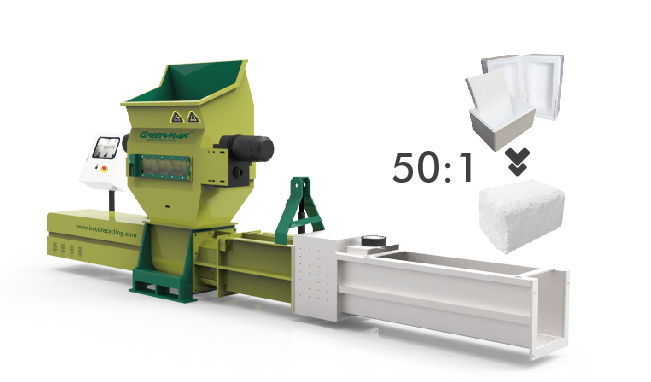
The test allowed WM to see how its own materials performed under real operating conditions. The team could evaluate the compression results and confirm that foam compactor Z-C200 was suitable for its EPS and EPE foam waste.
Reducing Storage and Transportation Costs
After compaction, WM's foam waste required significantly less storage space. The dense blocks could be stacked and handled more easily, helping the company make better use of its warehouse.
The reduced volume also improved transportation efficiency. Instead of moving large quantities of loose foam, WM could consolidate more material into each collection, reducing the logistical burden associated with bulky foam waste.
From Landfill to Recycling
The benefits went beyond volume reduction. Previously, much of WM's foam waste was sent to landfill. By compacting EPS and EPE into dense blocks, the material became easier to store, transport, and send to downstream recyclers.
Through the GREENMAX recycling network, compacted foam can be processed into recycled plastic feedstock for applications such as picture frames, decorative mouldings, and other plastic products.
Why WM Chose GREENMAX
WM's decision was based on actual material testing rather than specifications alone. Foam waste can vary in density, size, flexibility, and condition, so testing the customer's own material is an important step when selecting a foam recycling machine.
After testing the Z-C200 at the GREENMAX factory, WM placed an order and installed the machine for its foam waste management operation in Singapore.
A More Efficient Approach to Foam Waste
The WM case shows how foam compaction can do more than reduce waste volume. For companies handling large amounts of EPS and EPE, it can help reduce storage pressure, improve transportation efficiency, and make recyclable foam easier to manage.
For logistics companies, packaging businesses, manufacturers, and warehouses, evaluating the actual foam waste and testing it with recycling equipment can provide a practical basis for choosing the right solution.
For WM, the GREENMAX Z-C200 reduced foam waste volume by approximately 50 times, turning a bulky waste problem into a more manageable material stream with greater potential for recycling.
CASES
-
VIP Partner
-
EUROPE
-
OCEANIA
-
AFRICA
-
SOUTH AMERICA
-
NORTH AMERICA
-
ASIA
- DOW
- AI Dossary Group
- Pepsico
- KANEKA
- NARIYAMA SHOTEN
- Government Enterprise
- SIS RESOURCES
- ACI Chemicals
- Sharwin Foam
- LOVERE
- SANKO Corporation
- F.E.FOAM
- SHENG SIONG
- Chengtou Environmental Group
- San Gong
- KIMURA
- China
- Xiamen
- Shanghai
- Shanghai
- Japan
- Japan
- Japan
- Japan
- Malaysia
- Malaysia
- Malaysia
- Singapore
- Israel