 Select Language
 English
 Spanish
 Polish
 Japanese
 Italian
 French
White Foam Recycling for Solar Battery Packaging | PE Foam & EPS Solutions
The solar industry is growing rapidly worldwide. In the United States, solar has become a leading energy source, with over 30 GW of new capacity added in 2025. As more businesses and households adopt solar and energy storage systems, packaging waste from this sector continues to increase.
The solar supply chain is extensive—from manufacturing to transportation and installation—generating large amounts of protective packaging such as EPE (polyethylene foam) and EPS (polystyrene). This is mainly because:
· Solar panels are fragile (glass + solar cells) and require cushioning protection
· Global logistics involve long-distance shipping, requiring durable packaging
· Many components need protection, including inverters, batteries, and storage systems
Why Do Distributors and Installers Face Challenges?
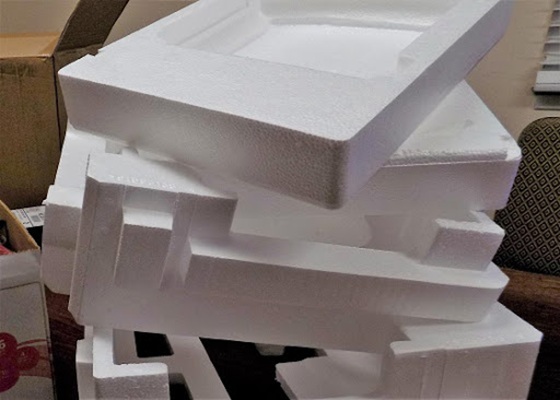
Foam packaging waste is generated across multiple stages of the solar supply chain, especially at job sites, warehouses, and distribution centers.
Imported battery systems are typically packed with thick EPS inserts, foam corners, and PE foam sheets to prevent damage. Once delivered, these materials are removed before storage or installation. Installers also unpack systems directly on-site, leaving behind large quantities of foam waste.
Although lightweight, foam takes up significant space. A truckload of loose EPS may weigh only a few hundred pounds but occupies a large volume, leading to high storage and transportation costs.
As a result, managing foam waste and implementing efficient EPE recycling and polystyrene recycling solutions has become a key challenge for solar-related businesses.
Sustainable EPS & EPE Recycling Solutions
In the United States, under federal and state environmental regulations (such as the Resource Conservation and Recovery Act, RCRA), companies are required to properly manage packaging waste. At the same time, policies encourage material recycling and resource reuse to reduce landfill and incineration, promoting the development of a circular economy.
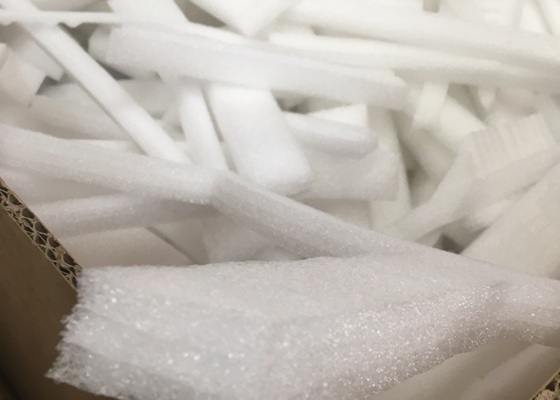
The most common and cost-effective solution for EPE recycling and EPS recycling is to use specialized compaction equipment to reduce volume, then sell the compressed blocks to downstream recyclers for pelletizing and manufacturing new products, completing the material loop. In some regions, environmental programs or circular economy initiatives may also provide support or subsidies for recycling equipment investments.
A foam densifier can reduce foam volume by up to 90 times, transforming bulky waste into neat, dense blocks that are much easier to store and transport, while also lowering logistics costs. However, for companies in the solar industry, the key challenge is selecting a versatile machine that can process both PE foam and handle polystyrene recycling.
Foam Recycling Equipment for the Solar Industry
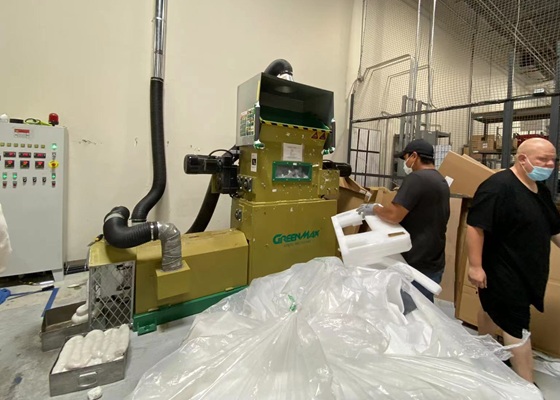
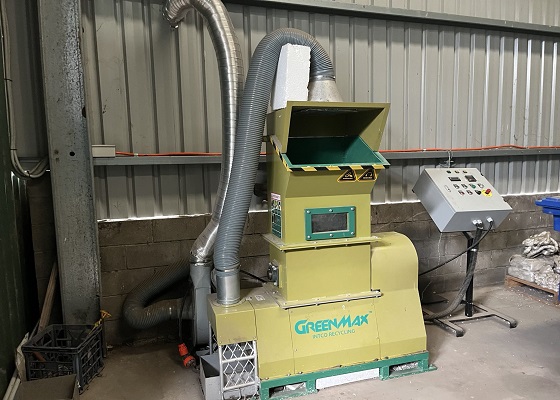
GreenMax offers a thermal foam densifier designed to process both EPS and EPE, making it an ideal solution for mixed foam waste.
The machine shreds the foam, melts it through a heating system, and extrudes it into high-density blocks. This process greatly reduces volume while remaining easy to operate with minimal labor.
For on-site use, the mobile EPS extruder M-C50E can be mounted on a trailer or truck for flexible recycling across multiple locations. For fixed facilities like warehouses, standard models such as M-C100 or M-C200 are recommended.
Key advantages include:
· Processes both EPS (polystyrene) and EPE
· Mobile and stationary options for different applications
· Compressed material can be recycled into new products
FAQ
1) Why can thermal machines process mixed EPS and EPE waste?
Thermal densifiers soften and reshape foam through heat, allowing both materials to be processed together. However, basic sorting is recommended to improve block quality and resale value.
2) Is there a market for compressed EPS and EPE blocks?
Yes. In the U.S., compressed foam blocks are widely accepted by recyclers. GreenMax purchases EPS blocks for applications such as frames, decking, and panels, while companies like Sealed Air reuse PE materials for new packaging products.