 Select Language
 English
 Spanish
 Polish
 Japanese
 Italian
 French
Turn Production Scrap Into a Standard Commodity: A Repeatable EPE Recycling Path for PE Packaging Plants
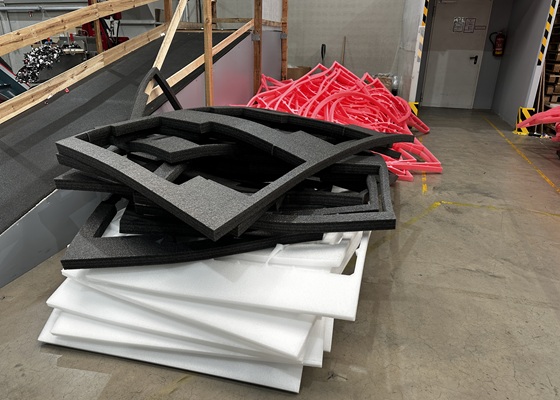
In the packaging industry, EPE (polyethylene foam) is widely used for protective inserts, trays, corner guards, and other cushioning products. But for manufacturers, cutting and forming almost always creates large volumes of PE foam offcuts. The challenges are familiar: bulky material that piles up fast, high transportation costs, and valuable production space lost to scrap storage.
To reduce accumulation, improve space utilization, cut disposal expenses, and enable reuse, most plants choose one of three common EPE recycling approaches—each with very different investment levels and returns.
Three Common Polyethylene Recycling Options for EPE Scrap
Option A: Install a Pelletizing Machine (Closed-Loop Reuse In-House)
Many large producers set up a pelletizing line on-site. Scrap is shredded and pre-compacted, then conveyed into a silo before feeding into a pelletizing machine. The resulting pellets can go back into PE packaging production for internal reuse.
· Pros: Strong closed-loop capability, controlled raw material, lower virgin resin consumption.
· Cons: High upfront investment, more complex system, and ongoing maintenance/management requirements.
Option B: Buy a Foam Shredder and Sell Shredded Material
A foam shredder breaks large offcuts into more uniform pieces that can be bagged and stored, reducing volume to some extent and improving warehouse organization.
· Pros: Lower investment and fast to implement.
· Cons: Shredded foam is still relatively loose, shipping efficiency is limited, and market prices are often lower than densified blocks or recycled PE pellets.
Option C (GreenMax Recommended): Densify First, Then Decide to Sell or Go Closed-Loop
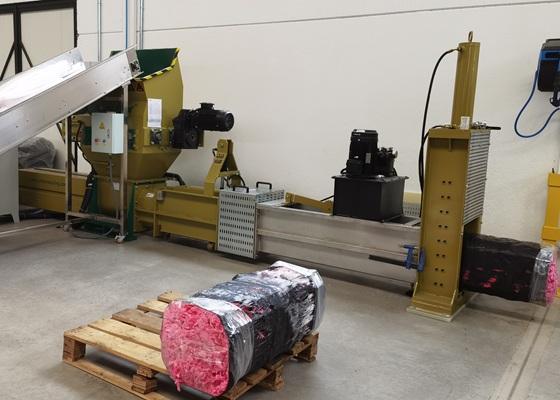
A foam densifier compresses loose EPE offcuts into dense blocks at 50:1 or 90:1 volume reduction. The result is easier to handle, store, and ship—and the selling price is typically higher than shredded material, which helps improve overall returns.
In terms of investment, a foam recycling machine (densifier) generally costs more than a foam shredder, but significantly less than a full pelletizing machine line. And if your plant later decides to add deeper processing, you can connect a pelletizer downstream—without leaving the densifier underutilized.
When you weigh investment vs. payoff, a polyethylene densifier is often the best value for most packaging manufacturers pursuing EPE recycling.
Best Fit for Continuous Scrap Generation: GreenMax Polyethylene Densifier Z-C200
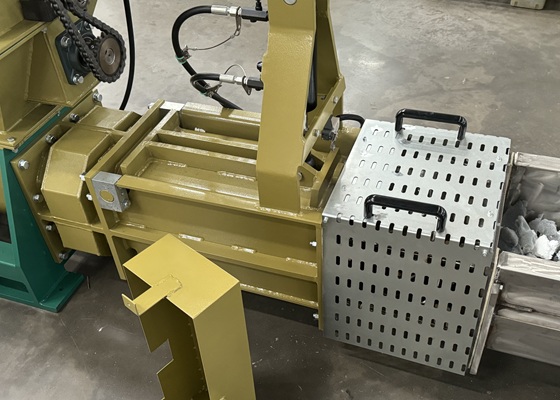
For plants generating offcuts continuously, the GreenMax polyethylene densifier Z-C200 is a strong fit. It combines screw-based physical compression with surface heat treatment to reduce rebound after densification—while keeping energy use relatively low. Because it relies on physical densification, the foam’s core material properties remain largely unchanged, which can make it easier to sell.
· High throughput: about 200 kg/h, suitable for mid-to-large plants.
· Low labor requirement: typically one operator can handle feeding and block handling.
· Easy to scale: can connect to a pelletizing line later to build a more complete closed-loop system.
· Customization available: layout planning, design, and manufacturing based on your site flow, space, and feeding method.
· Industry 4.0 monitoring: network-enabled status monitoring and parameter adjustment, with data insights to keep compression more consistent.
On-Site Tuning Example: Higher Density vs. “Surface Melting”
One customer wanted higher-density blocks for their polyethylene recycling program, but during setup they ran into an issue: surface heat treatment was held too long, raising the surface temperature and causing partial melting, which affected block consistency.
GreenMax engineers supported the site with three adjustments:
1. Set surface temperature to 140°C—but start feeding earlier. Begin feeding when the heating component reaches 100–120°C. By the time material reaches the surface heating stage, temperature approaches 140°C, helping prevent overheating.
2. Adjust the compression rhythm for EPE rebound. Increase the discharge plate press-down time to 4 seconds so the foam is more fully compacted before surface heat treatment, improving density.
3. Match screw output. Set the screw speed to about 20 r/min to balance feeding and forming.
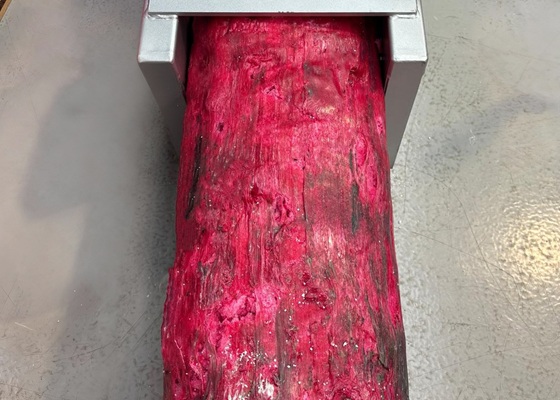
After a continuous 1-hour run, the EPE recycling output was stable: block cross-section about 380 × 380 mm, length about 1 m, weight about 30 kg. The customer achieved the target look and density while avoiding the melting issue.
Video: Here’s the machine running after the customer’s tuning adjustments.
Recommendation for Packaging Manufacturers
If your goals are to (1) reduce floor space and pickups, (2) lower handling and disposal costs, (3) improve resale value and shipping efficiency, and (4) keep an option open for future in-house reuse, starting with a GreenMax polyethylene densifier is often a smart step. It’s a controlled investment with clear returns—and a practical upgrade from simply “disposing scrap” to “managing recyclable material.”