 Select Language
 English
 Spanish
 Polish
 Japanese
 Italian
 French
All-in-One EPS Recycling Solution for Block Scrap & Dust in Building Insulation Board Plants
Why EPS Scrap Is a Persistent Problem in Insulation Board Manufacturing
In construction, EPS (often called Styrofoam) is widely used for insulation, thermal performance, and lightweight building systems—common across floors, walls, and integrated building assemblies. But in the production of EPS insulation boards, waste is nearly unavoidable.
Typical waste includes block offcuts, edge trim, and EPS powder. In particular, laser cutting can generate large quantities of fine Styrofoam dust.
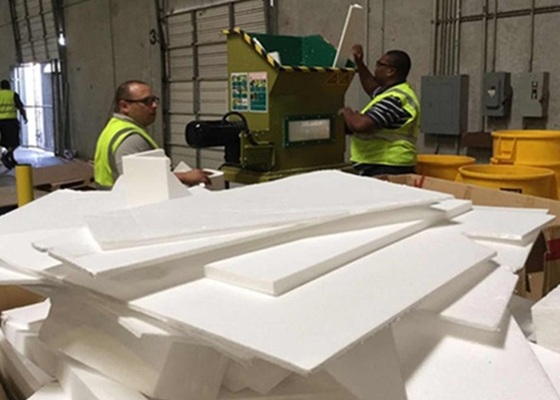
Example: Mid-Sized Plant Waste Volume
· Daily EPS output: ~6 tons
· Scrap generated: ~1,280 kg/day
· Loose density of EPS waste: typically 8–16 kg/m³
Some scrap can be reused, but a significant portion is often out-of-spec or contaminated and cannot go back to the production line. Over time, waste piles take up valuable floor space, increase handling costs, and lead to higher hauling fees and environmental pressure—this is a common challenge for EPS insulation board producers.
The good news is that EPS waste has a clear recycling pathway. Many recyclers run EPS buyback programs, including GREENMAX. Recycled EPS can be processed into recycled polystyrene (PS) materials and blended (at an appropriate ratio) into new products, helping reduce virgin material use and overall production cost. This closed-loop approach is becoming an industry trend.
Why a Heat-Based EPS Recycling Process Works Better for Building EPS Waste
For insulation board plants, an ideal recycling method should meet three requirements: handles blocks, handles dust, and produces consistent, tradable output.
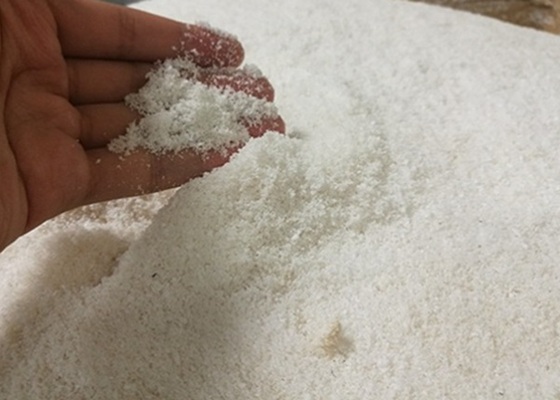
Compared with cold-compaction solutions, a foam densifier is typically better at handling fine Styrofoam powder. By using heat to melt EPS into a semi-fluid state, the system allows dust to blend and fuse into the densified material, reducing airborne scatter and improving recovery.
Cold-compaction machines rely mainly on mechanical screw compression. Fine powder may not always pack perfectly, and dust can continue to spill from the edges of compressed blocks—reducing recycling effectiveness and making the work area messier.
The GREENMAX Solution: Foam Densifier + Feeding Screw for Blocks and EPS Dust
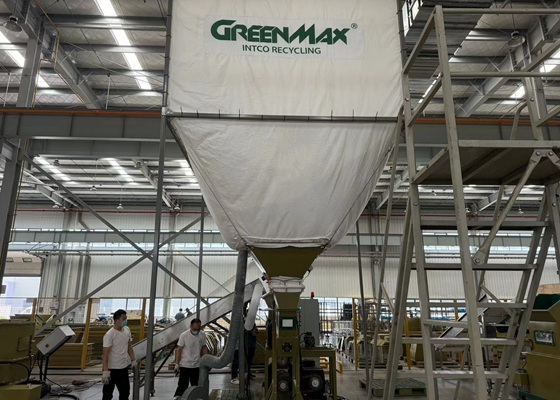
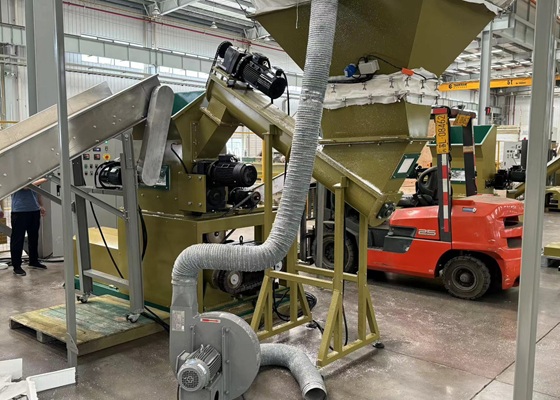
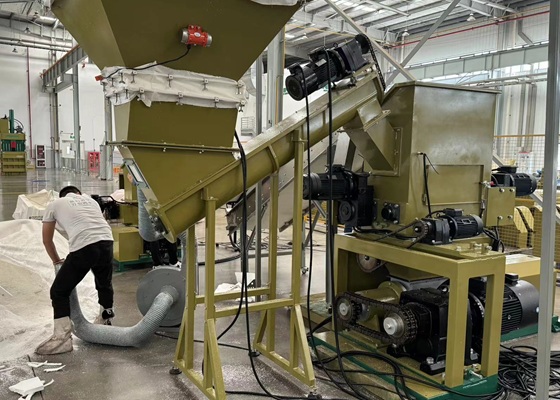
For EPS insulation board manufacturers, GREENMAX typically recommends a configuration that includes the foam densifier M-C200, a feeding screw conveyor (auger), and a belt conveyor.
· Throughput: approximately 200 kg/h (suitable for mid-sized plants)
· Stable feeding: the screw conveyor helps prevent fine powder build-up and clogging at the inlet, supporting continuous, steady input
How the Process Works
1. Block scrap crushing: bulky EPS scrap is reduced to uniform flakes and stored in a silo.
2. Dust collection: EPS powder is continuously captured via a blower and piping system and routed into the same silo for centralized storage.
3. Continuous feeding: once the silo reaches capacity, the feeding screw delivers both flakes and powder into the heating chamber at a controlled rate.
4. Melting + densifying: the material is heated and compressed (up to 90:1 volume reduction) and then extruded into dense output.
With a dual-channel approach—crushing for blocks plus vacuum collection for dust—both streams merge in the silo and are processed together. Instead of manually bagging and hauling dust, plants can feed it continuously into the recycling line along with block scrap, improving efficiency and reducing labor.
Maintenance & Spare Parts: Reduce Downtime and Prevent Waste Piles
Wear parts will eventually need replacement in long-term operation. GREENMAX helps reduce the risk of downtime caused by waiting on parts by using components from widely available global brands such as PHOENIX, SCHNEIDER, and NSK. In many cases, plants can source compatible replacements locally.
GREENMAX also provides long-term spare parts support. However, local replacement is often the fastest way to minimize downtime and prevent EPS waste from piling up again due to stoppages.
Where the Recycled Output Goes: Clean White Material + Buyback Support
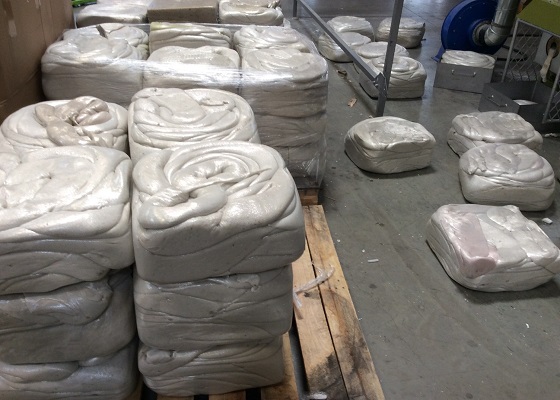
The Foam Densifier M-C200 can produce clean white densified EPS that is easier to store, transport, and recycle downstream. GREENMAX also offers an EPS buyback program. As a reference, buyback pricing may be around $550–$580 per ton (subject to real-time market conditions).
Densified EPS can be used in the production of recycled products such as outdoor decking, acoustic wall panels, and other eco-friendly applications.
If you’d like multiple sales channels, GREENMAX can also help connect you with local outlets. With a global EPS recycling network, we’re familiar with regional recycling flows and trading practices.
See the Recycling Results: Trial Runs or Site Visits
To make the project more predictable, we offer two “see it first” options:
- Visit facilities in Vietnam, Malaysia, or China to observe and participate in a trial run of the Foam Densifier M-C200.
- If international travel isn’t convenient, we can also arrange visits to operating customer sites locally so you can see compression results and machine performance in person.
FAQ: EPS Recycling for the Building Industry
Q1: Can EPS dust really be recycled?
Yes. The keys are steady feeding and a matched process. With a feeding screw and conveyor, EPS dust can be delivered continuously into the system and processed together with block scrap—reducing the cost and mess of manual bagging and hauling.
Q2: Will the recycled material definitely sell?
It’s much easier to sell when the material is clean, consistent, and efficient to transport. If you want a more secure outlet, GREENMAX can provide an EPS buyback program option and help you build a diversified local sales strategy.