 Select Language
 English
 Spanish
 Polish
 Japanese
 Italian
 French
Cold-Press or Thermal-Melting Polystyrene Compactor: Which One Is Better?
Polystyrene recycling mainly relies on compression-type equipment. The GREENMAX polystyrene compactor and EPS densifier offer two efficient solutions for waste treatment.
Each has its own advantages and is suitable for different application scenarios. However, many users are still confused about the differences between the two types of equipment and how to choose between them.
So today, let’s talk about this: When choosing an EPS recycling machine, how should you decide between cold compaction and thermal melting?
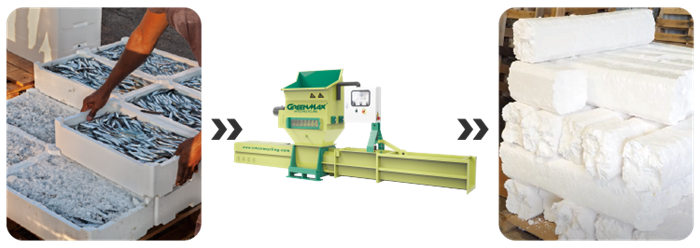
1. GREENMAX Polystyrene Compactor
This machine compresses foam using strong mechanical pressure. Once the foam enters the equipment, it is crushed and compacted, significantly reducing its volume.
Main advantages include:
• No heating, low energy consumption: Helps reduce operating costs, especially suitable for companies with limited power resources or those focused on energy saving.
• Preserves material properties: The foam's chemical characteristics remain unchanged during cold compaction, making it ideal for reprocessing scenarios that require original material integrity, such as manufacturing specific plastic products.
• Simple operation, low maintenance: Easy to use and low maintenance costs, suitable for stable long-term polystyrene recycling operations.
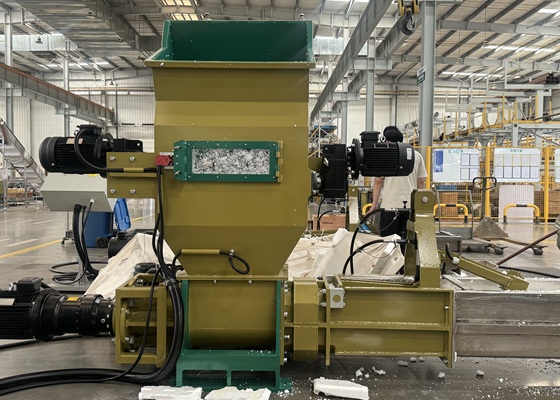
2. GREENMAX EPS Densifier
This type of EPS recycling machine uses thermal melting technology to process foam. The foam is heated to a set temperature, melted, and then extruded through a screw.
Main advantages include:
• Higher volume reduction rate: Foam can be compressed to 1/90 of its original volume—far more than cold compaction—significantly reducing storage and transportation costs.
• Better for pelletizing: The dense blocks formed after melting are more suitable for pelletizer capacity requirements, improving pelletizing and reuse efficiency.
• User-friendly operation: Just a start/stop button and temperature adjustment are needed; even inexperienced workers can quickly operate the machine, lowering the entry barrier for foam recycling.
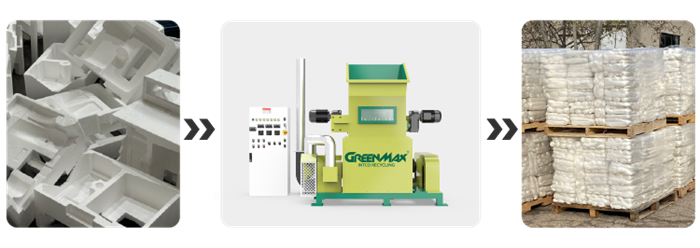
How to Choose Between the Two Types of Equipment?
Based on cost considerations:
If the company has a limited budget and needs strict energy control, the cold-press polystyrene compactor offers better cost-effectiveness. It features low energy consumption and low maintenance costs, helping reduce operational burden.
If the focus is on storage and transportation efficiency and the company can afford higher energy use, the EPS densifier, with its high compression ratio, can offer lower long-term overall costs.
Based on reprocessing requirements:
If it’s necessary to preserve the original structure of the foam—such as for producing high-end plastic products—the cold compaction machine is more suitable.
If the foam needs to be melted and modified, for example, pelletized into other plastic products, the hot-melt machine is better suited for this type of polystyrene recycling process.
Based on processing scale and efficiency:
For small daily volumes, the cold-press machine has a compact design, is easy to operate, and is ideal for small to medium-sized businesses.
If dealing with large amounts of waste and aiming for high efficiency and continuous operation, the EPS densifier is more suitable for large-scale recycling scenarios.
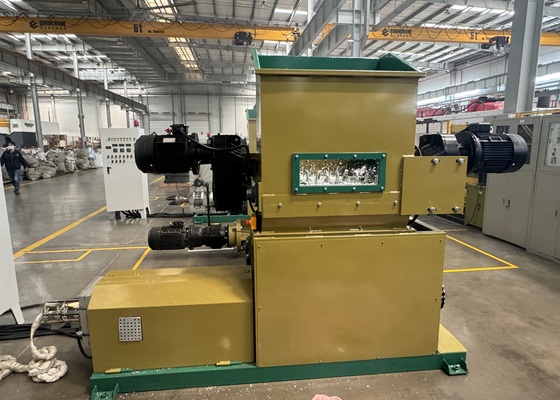
Both EPS recycling machines from GREENMAX bring innovative solutions to foam recycling. Companies should evaluate their actual needs and consider factors such as cost, reprocessing requirements, and production volume to make the most suitable choice—achieving both economic and environmental benefits.
If you have any questions about polystyrene recycling, feel free to contact GREENMAX at any time.