
 Select Language
 English
 Spanish
 Polish
 Japanese
 Italian
 French
EPP Recycling: Customization Is the Key
In the automotive industry, EPP (expanded polypropylene) is widely used throughout the entire supply chain, from protective packaging for transportation to structural components. However, in the recycling stage, EPP recycling is significantly more complex than handling EPS or EPE, which creates challenges when selecting the right EPP densifier.
Although EPP, EPS, and EPE are all foam materials, their properties differ greatly. EPS (expanded polystyrene) is commonly used in white packaging and is relatively brittle, making it easier to crush and compress. EPE (expanded polyethylene) is softer and flexible, widely used for electronics and appliance packaging. EPP, on the other hand, combines high strength and high resilience, making it suitable not only for packaging but also for automotive components such as bumper cores and seat structures.
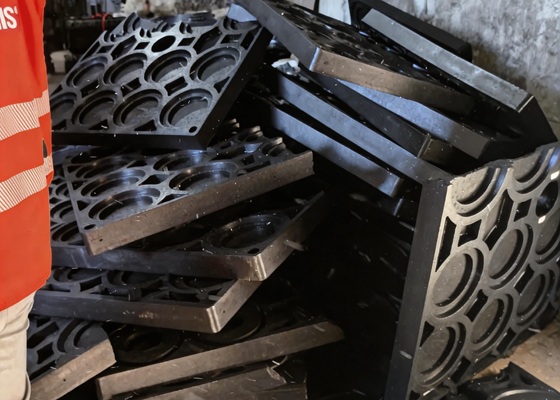
This combination of high strength and high resilience makes EPP more difficult to process. It is harder to shred in a single step and more challenging to compact. In addition, EPP materials vary significantly: some are highly flexible and difficult to tear, while others have high density (up to 80 kg/m³), making them unsuitable for standard compression equipment. These factors are the main reasons why EPP recycling is more complex.
GreenMax offers efficient solutions with its EPP densifier Zeus and Mars series, both designed for customized processing. If customers focus on resale value of compressed blocks, the Zeus series (cold compression with screw extrusion and surface densification) is recommended. For higher volume reduction or high-density materials (60–90 kg/m³), the Mars series (three-stage hot melting) delivers better results in expanded polypropylene recycling.
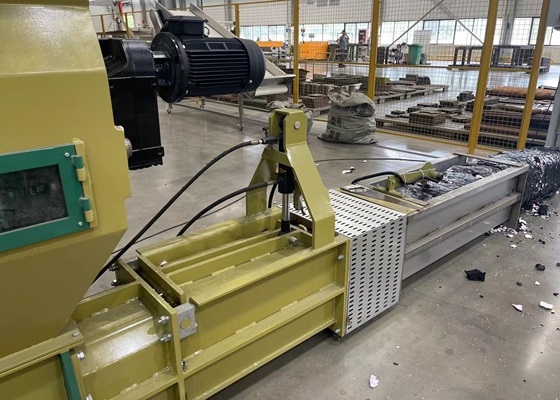
EPP for Automotive Components: High Strength & High Density
EPP used in automotive components typically has higher density and structural strength, requiring stronger shredding capability. For this application, GreenMax has optimized the shredding system of its foam densifier by using a dual-shaft shredding structure and upgraded blade materials. This ensures high-hardness EPP can be processed into uniform particles, providing a stable foundation for compression. The motor power is also increased (up to 22kW), ensuring stable operation under heavy loads.
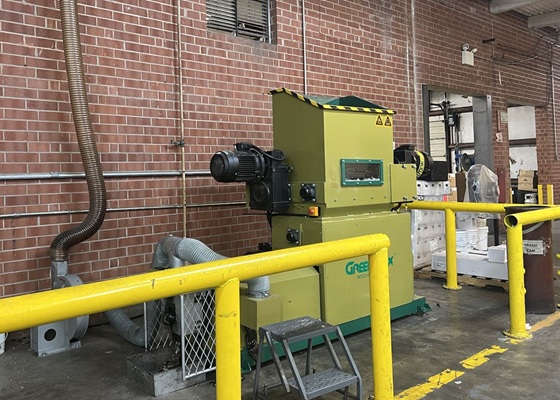
EPP for Packaging: Size & Resilience Challenges
In the automotive supply chain, EPP is widely used for protective packaging of engine parts, dashboards, and other precision components. These materials are often large in size and difficult to feed. Combined with EPP’s high resilience, standard machines often struggle with inconsistent feeding and uneven shredding.
To address this, GreenMax has enlarged the feeding inlet and shredding chamber while optimizing blade structure and materials. This allows large EPP pieces to be processed smoothly and efficiently, preventing blockages and improving overall EPP recycling efficiency.
For example, a German customer processing standard-density EPP trays adopted the EPP densifier Zeus Z-C200. The results were stable, producing compressed blocks measuring approximately 1 × 0.38 × 0.38 m and weighing around 50 kg, making them easy to transport and sell.
High-Density EPP: Balancing Melting & Feeding
When EPP density exceeds 70 kg/m³, it becomes difficult to balance melting time and screw feeding speed. Longer melting time reduces output efficiency, while shorter time leads to incomplete melting and poor volume reduction.
GreenMax addresses this by extending the melting chamber, allowing materials to remain longer without significantly reducing screw speed, ensuring more complete melting. For extremely dense EPP, an additional shredding stage is introduced to produce finer particles and improve melting efficiency.
GreenMax has provided the foam densifier Mars M-C300 to a leading Japanese automotive parts manufacturer, enabling stable processing of mixed EPP and EPO waste with densities above 60 kg/m³.
Why Customization Matters in EPP Recycling
In principle, EPS, EPE, and EPP can all be processed through “shredding + compression.” However, EPP requires higher performance in shredding strength, compression stability, and thermal design. Therefore, effective EPP recycling depends on customized solutions tailored to specific material characteristics.
Choosing the right equipment for expanded polypropylene recycling is not just about whether it can process EPP, but whether it can adapt to different types of EPP waste.
Additionally, in markets such as Europe and Spain, operator turnover is relatively high. Improper operation can reduce efficiency or even cause equipment failure. To address this, GreenMax pre-tests machines using customer materials (or similar ones) before delivery and stores optimized parameters in the system. Operators can simply select the appropriate mode on-site, or make minor adjustments if needed. This significantly reduces training time, minimizes operational errors, and ensures stable long-term performance.