
 Select Language
 English
 Spanish
 Polish
 Japanese
 Italian
 French
EPS Compactor: A Full-Cycle Solution for Construction Foam Waste
In certain climate-variable regions of the United States—such as Massachusetts, Michigan, and Colorado—the demand for lightweight insulation materials with excellent thermal performance is steadily increasing in construction projects.
EPS foam boards (commonly known as Styrofoam) have become a widely used insulation material due to their outstanding thermal insulation properties. They are commonly applied in walls, roofs, and floors. However, as usage continues to rise, the challenge of recycling large volumes of Styrofoam waste generated throughout the construction process has become an urgent issue to address.
In fact, Styrofoam recycling in the construction industry can be efficiently addressed with an EPS compactor. This EPS recycling machine is specifically designed to crush and compress bulky foam waste into dense blocks. It delivers excellent volume reduction performance and is suitable for a wide range of applications—covering foam waste handling across the entire construction chain.
But where exactly does Styrofoam waste come from during construction?
And how does this machine serve as an ideal one-stop solution for foam recycling?
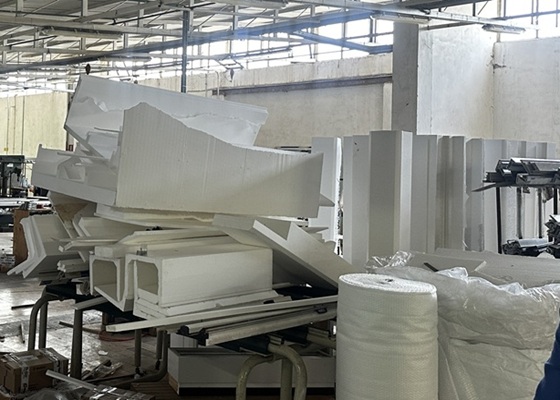
1. EPS Board Production Stage
During the manufacturing of EPS insulation boards, scrap materials, edge trimmings, and defective boards are commonly generated. These lightweight foams are bulky, easily scattered, and difficult to store or manage—often leading to significant production losses. As a result, many board manufacturers are eager to find an effective foam recycling solution to reduce costs and improve waste-handling efficiency.
This is where the EPS compactor comes into play. It compresses trimmings and foam dust into dense blocks, which can either be resold to other recyclers or reintegrated directly into the production process.
The EPS recycling machine uses cold-compression screw technology, applying strong mechanical pressure to shape the foam without damaging its physical properties. The resulting foam blocks are close to virgin material in quality.
These cold-compressed foam blocks are ideal for reprocessing into high-quality products, and in many cases, can even be directly reused to produce insulation boards—making them highly sought after in the recycled materials market.
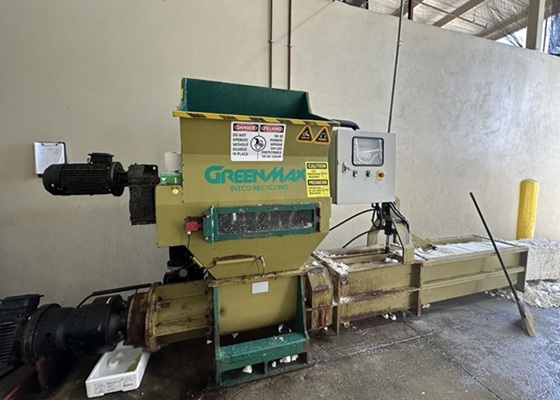
2. On-Site Cutting Stage
At construction sites, EPS insulation boards must be cut according to wall dimensions before installation. This process generates a large amount of edge trimmings and small foam scraps. These materials are scattered and unevenly distributed, making manual cleanup and transportation inefficient and costly. For site managers, one of the biggest challenges is how to quickly handle this foam waste while minimizing transport expenses.
At this point, an EPS compactor can compress the waste down to 1/50 of its original volume. The resulting foam blocks can be stacked directly onto pallets and transported efficiently by truck—greatly improving the effectiveness of Styrofoam recycling on site.
In addition, GREENMAX offers mobile units that can be mounted on vehicles for flexible use on construction sites, reducing manual collection labor and making foam recycling more convenient and efficient.
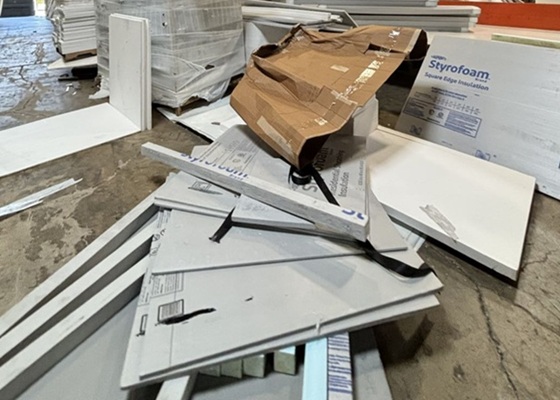
3. Demolition or Renovation Stage
During building renovations or demolitions, large volumes of used EPS panels are stripped off and discarded. Due to their bulky nature and the lack of basic recycling infrastructure, these foam materials are often sent directly to landfills. However, with increasingly strict environmental regulations, landfilling is no longer a viable option, and companies must seek sustainable Styrofoam recycling solutions.
With the help of an EPS recycling machine, the foam waste can be densified and transformed into a marketable recycled material. This not only saves warehouse space but also enables resale to downstream recyclers—turning waste into value and creating additional revenue for construction projects.
At the same time, installing an EPS compactor helps companies build a positive ESG (Environmental, Social, and Governance) image, align with regulatory policies, and enhance their competitiveness in the market.
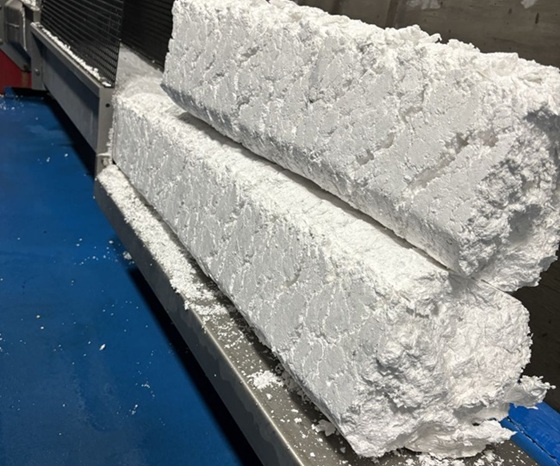
An EPS compactor means that construction companies can not only reduce the cost of disposing foam waste, but also actively participate in the recycling loop of sustainable building materials.
This leads to:
– Cleaner construction sites
– Lower operating and transportation costs
– A stronger corporate environmental image
– And project solutions that align with U.S. green building policies
Contact us to learn more!