 Select Language
 English
 Spanish
 Polish
 Japanese
 Italian
 French
EPS Fish Box Waste for Seafood Businesses: Packaging Piles → Sellable Compacted Styrofoam Blocks
The United States is one of the world’s major seafood consumption markets, and its seafood supply relies heavily on imports and cold chain distribution. Both domestic landings and imported seafood volumes are significant. Dutch Harbor has long been one of the leading U.S. ports by seafood landings, while New Bedford has remained one of the top ports by landing value. At the same time, the U.S. imports billions of pounds of edible seafood every year, including fresh fish, shrimp, crab, lobster, salmon, and frozen seafood that must move through cold chain packaging and distribution.
Throughout this supply chain, EPS fish boxes and insulated foam containers are widely used for seafood transportation and temporary storage. In the U.S., this material is often commonly referred to as Styrofoam, although it is typically EPS foam. It offers insulation, moisture resistance, light weight, cushioning, and strong suitability for food transportation. As a result, it is commonly seen in seafood processing plants, wholesale markets, cold storage facilities, supermarket backrooms, and foodservice supply chains.
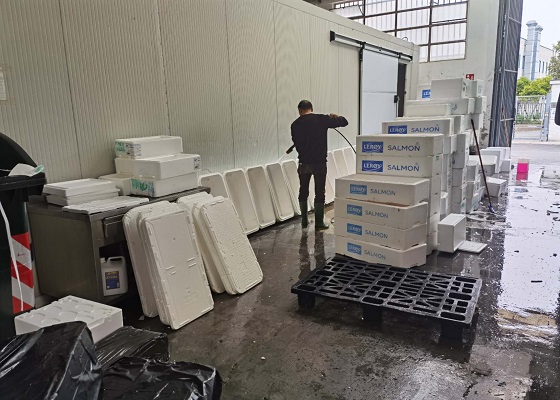
If each seafood box holds around 20–40 pounds and is discarded after 1–2 turns, the amount of EPS fish box waste generated by the U.S. seafood industry can be considerable. Behind these numbers is a familiar scene: white foam piles growing higher behind cold rooms, processing plants, and distribution centers. The material is light, but it takes up valuable space; it weighs little, but it increases hauling frequency and transportation costs.
The Three Real Costs Seafood Businesses Face
1. Space Cost
EPS fish boxes are lightweight but bulky. When large volumes of foam boxes pile up behind cold storage areas, loading docks, or warehouse corners, they occupy space that could otherwise be used for seafood inventory, cold chain equipment, or product turnover.
2. Hauling Cost
Loose foam boxes have very low loading efficiency. In many cases, companies are not paying to move weight; they are paying to move air. If the material is handled by a third-party hauler, costs are often quoted based on distance, volume, pickup frequency, and service conditions, becoming an ongoing operating expense.
3. Compliance and Penalty Risk
In the U.S., some states are advancing Extended Producer Responsibility (EPR) programs for packaging. Companies may need to take on packaging reporting, fees, or recycling responsibilities, depending on their role and location. Seafood wholesalers, processors, and cold chain distribution centers should pay attention to local regulations and maintain proper sorting, storage, hauling, and recycling records.
If a company cannot build its own EPS recycling system, it will continue to face foam box accumulation, hauling costs, and space pressure in daily operations. As environmental policies tighten, customer ESG expectations increase, and competition becomes stronger, businesses without a clear recycling process may find themselves in a more passive position.
Two Paths: Paid Hauling vs. In-House Volume Reduction
The traditional path is to hand over used EPS fish boxes to a third-party hauler. In the U.S., this service is often charged by pickup or service frequency, with a typical reference range of around $150–$200 per pickup depending on location, distance, and volume. The advantage is simplicity. The downside is that long-term costs can be hard to control: the more boxes generated, the more frequent the pickups, and the higher the total cost.
Another hidden cost is on-site accumulation. Foam waste stored inside or around the facility reduces space that could otherwise support seafood storage, cold chain turnover, loading operations, or warehouse movement.
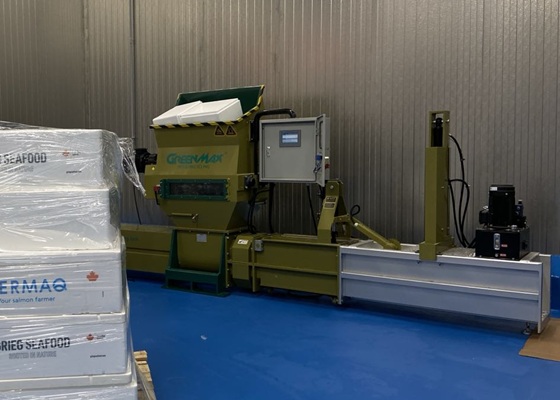
The EPS recycling path is different: seafood businesses reduce the volume of waste fish boxes directly inside the facility and sell the compacted EPS blocks.
· Investment: By investing in a foam volume reduction system, companies can process their own packaging waste. A GREENMAX Styrofoam compactor usually requires an investment of around $20,000–$50,000, depending on machine configuration. Once installed, loose EPS fish boxes can be compacted into high-density EPS blocks at a reduction ratio of up to 50:1, significantly reducing volume and transportation frequency.
· Output value: Compacted EPS blocks can currently reach around $670 per ton in market value, depending on quality, location, buyer requirements, and market conditions. Larger buyers may work with monthly or long-term purchase agreements. Seafood businesses can sell the blocks to GREENMAX, plastic product manufacturers, or other recyclers, creating continuous recycling revenue.
· Payback and direct return: If a facility generates 5 tons per month and sells compacted blocks at $530 per ton, monthly recycling income can reach about $2,750, or roughly $33,000 per year. In many cases, the investment can be recovered within 12–18 months. After that, foam changes from a cost item into a profit item.
· Two hidden benefits: After EPS fish boxes recycling, the released space can be reused for cold storage turnover, seafood inventory, or loading operations. At the same time, when facing customer ESG requirements or local environmental policies, the company can better demonstrate its recycling capability and circular waste management process.
If you would like to understand the detailed ROI of this project, you can contact GM. Based on monthly foam waste volume, pickup frequency, space cost, and compacted block selling price, a more specific return-on-investment estimate can be calculated.
GREENMAX Foam Recycling Machine Apolo Series for Wet Fish Boxes
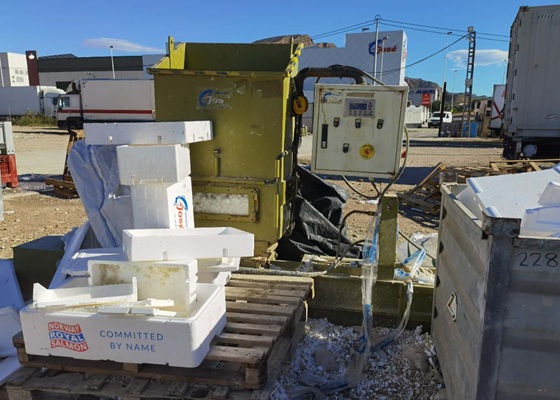
The GREENMAX Apolo Marine Series cold compactor is designed for wet EPS waste such as fish boxes, seafood boxes, and cold chain foam packaging. The equipment uses screw crushing and strong mechanical compression to compact loose foam boxes into high-density blocks with a volume reduction ratio of up to 50:1. The final density can reach around 200–400 kg/m³, making the blocks easier to stack, pack, transport, and sell.
Compared with hot-melt equipment, a cold-press Styrofoam compactor is more suitable for wet fish boxes. The screw compression technology is less affected by moisture and also offers lower energy consumption. For example, a machine with a processing capacity of around 100 kg/h usually consumes less than 20 kW.
Seawater, fish liquids, and humid environments can be highly corrosive to ordinary carbon steel. For this reason, the Apolo Marine Series includes material upgrades: the compression chamber and discharge area are made of stainless steel, improving the rust resistance of the foam recycling machine and extending its service life in fish markets, ports, seafood processing plants, and cold chain facilities.
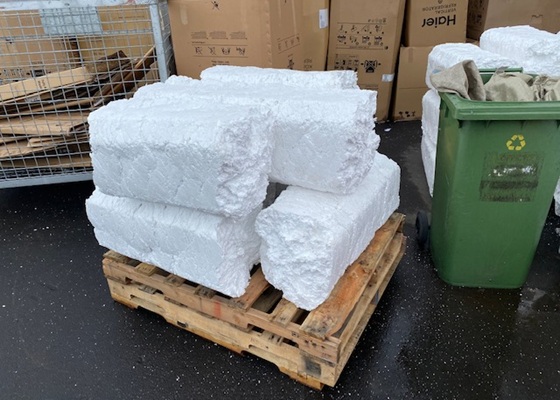
GREENMAX focuses on foam volume reduction and recycling solutions. Its Apolo Marine Series cold compactor has been applied in seafood-related recycling scenarios and is suitable for seafood businesses that need to reduce EPS fish box volume, improve storage efficiency, and build a more stable EPS recycling system. For an on-site evaluation or customized proposal in the U.S., please leave a message via WhatsApp.