
 Select Language
 English
 Spanish
 Polish
 Japanese
 Italian
 French
GreenMax Offers Front-End EPP Foam Compactor Solutions and Back-End Experience in EPP Pellet Modification Applications
CATL is a global leader in power batteries. The company established its German subsidiary in 2014 and later expanded its European battery manufacturing layout in Thuringia. Its German facility has also become an important part of CATL’s global battery manufacturing network.
In new energy battery facilities like this, EPP foam is widely used for the circulation, packaging, and transport protection of battery modules, battery packs, and components. EPP is lightweight, impact-resistant, and reusable, making it suitable for protecting high-value products. However, it also continuously generates production scraps, damaged reusable packaging, and discarded protective packaging.
It is understood that CATL’s German facility generates approximately 6,000 tons of EPP waste each year. In the waste handling process, the main challenges include high moisture content, heavy equipment wear caused by high-density waste, and limited downstream application scenarios. GreenMax has extensive experience in EPP recycling and has provided solutions for similar issues, offering practical reference for companies facing these recycling challenges.
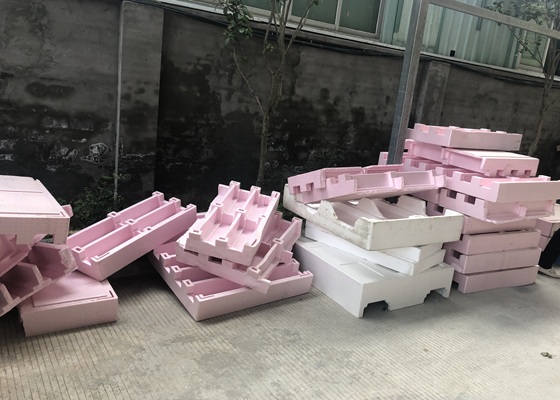
1. High Moisture Content in EPP Waste
Due to the large volume of EPP waste generated, some materials usually need to be temporarily stored before centralized processing. If the waste is stored outdoors, rain or snow can significantly increase its moisture content, making later volume reduction more difficult.
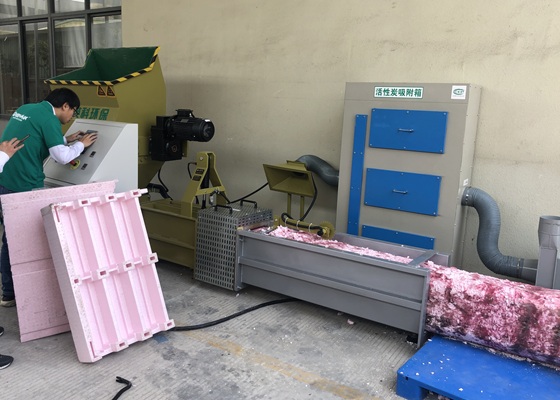
For this type of high-moisture EPP waste, GreenMax recommends using a cold-pressing EPP foam compactor. The equipment combines mechanical screw compression with surface heat-melting technology. This helps reduce overall energy consumption while improving the forming stability of the compressed blocks through surface melting at the outlet. As a result, it is more suitable for processing EPP materials with relatively high moisture content.
During operation, the foam recycling machine first shreds the waste, then sends the pieces into the compression chamber. The screw continuously compresses the material into high-density blocks with a compression ratio of about 50:1. At the outlet, the surface of the formed EPP blocks is heat-treated to make the structure more stable.
In addition, for wet waste conditions, key parts of the equipment can be upgraded to stainless steel. This helps improve corrosion resistance, reduce equipment wear, and extend the service life of the machine.
2. High-Density EPP Waste Is Difficult to Process and Causes Greater Equipment Wear
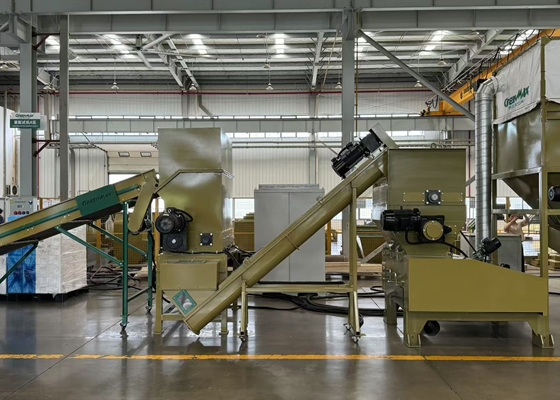
A common EPP recycling process is to shred the waste first and then compress it through a screw system. However, high-density EPP is harder. If the material is not shredded finely and evenly enough, the compressed blocks may not form stably during the compaction process.
Based on GreenMax’s experience, high-density EPP waste should be processed into sufficiently small and uniform pieces before entering the compression chamber. This helps improve the stability of the final compressed blocks.
Therefore, for this type of high-density material, two shredding stages can be added, together with screens of different hole sizes. This ensures that the waste entering the compression stage meets the required size standard, while oversized pieces continue to be shredded. At the same time, the shredder blades should be upgraded to more wear-resistant materials to handle the higher hardness of dense EPP.
For the most frequently worn shredder blades, the GreenMax EPP foam compactor supports individual disassembly and replacement. This avoids replacing the entire machine due to local wear and helps reduce maintenance costs.
A similar double-shredding solution has also been used by GreenMax in a Toyota Japan project for EPP waste with a density of about 50–60 kg/m³, receiving positive feedback.
3. Limited Downstream Application Scenarios
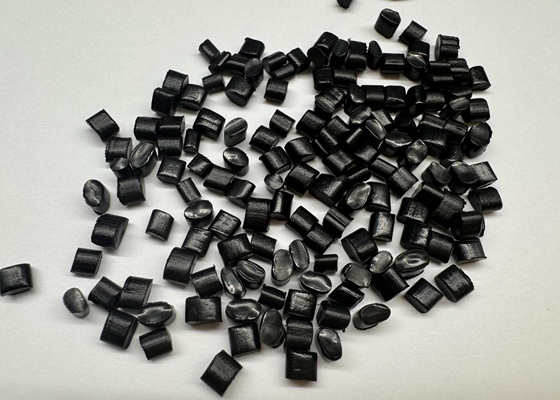
The direct reuse rate of EPP pellets after simple pelletizing is usually limited. A better approach is often to modify the material first. Modification means adjusting formulas, additives, and processing methods to improve the strength, toughness, heat resistance, or flowability of recycled PP pellets, making them more suitable for new products.
GreenMax is part of INTCO Recycling. INTCO Recycling has long purchased compressed foam blocks and used recycled foam materials to produce building products. It also has experience in pelletizing and modifying recycled EPP materials, which can be further used in mobility scooter parts, injection-molded products, and other applications.
In other words, GreenMax can provide not only front-end expanded polypropylene recycling solutions for waste volume reduction, but also more practical recommendations based on downstream modification and application experience. For example, GreenMax can offer reference suggestions on key indicators such as tensile strength and melt flow index, helping customers reduce repeated testing and improve recycling application efficiency.
For large battery manufacturers, the challenge of EPP recycling is never just about “compressing waste.” Front-end processing, equipment adaptation, and downstream reuse need to be considered together.
By planning around three key issues—wet materials, high-density EPP waste, and recycled pellet modification—companies can better combine an EPP foam compactor with a practical downstream application path. This makes it easier to turn EPP waste handling into a more sustainable and complete recycling chain.