 Select Language
 English
 Spanish
 Polish
 Japanese
 Italian
 French
How to Solve Odor Concerns with a Hot-Melting EPS Densifier?
In EPS recycling, hot-melting foam volume reduction equipment has remained popular because of its strong compaction performance. Compared with ordinary cold-press equipment, a polystyrene hot melting machine can achieve a compression ratio of up to 90:1, making it one of the most efficient volume reduction solutions on the market. This allows more compressed foam material to be transported in the same space, helping companies reduce storage and transportation costs.
This type of equipment usually shreds EPS, EPE, EPP, and other foam waste first. The shredded material is then sent into a high-temperature melting chamber. Under continuous heating, the foam pieces gradually become semi-fluid and are finally extruded by a screw system into neat blocks collected on a receiving tray. For companies that need to process large volumes of foam waste, an EPS densifier offers several advantages, including easy operation, a high volume reduction ratio, and low maintenance costs.
However, hot-melting equipment inevitably produces some odor during operation. This is one of the main concerns for companies that care about environmental protection and workplace conditions. Will the odor affect the working environment? Could it have a negative impact on people or the surrounding area?
To address these concerns, GreenMax provides solutions from three key aspects.
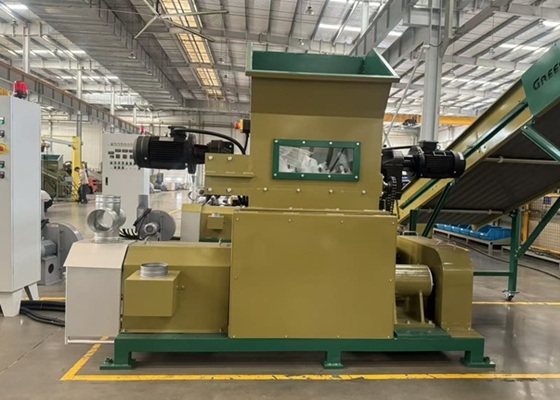
1. SGS Odor Test Report for Reliable Evaluation
GreenMax conducted an odor test under real operating conditions for its Mars series EPS densifier M-C200, which has a processing capacity of 200 kg per hour. GreenMax can also provide a valid and reliable SGS test report.
SGS is a globally recognized inspection, testing, and certification organization. Its reports are widely used as credible references in industrial equipment, environmental compliance, and product certification.
The test was conducted at 24.2°C with 56% RH humidity. A total of 27.15 kg of foam was processed, and the production time was 6 minutes and 56 seconds. Based on the calculation, the processing efficiency reached approximately 237.98 kg per hour.
This result shows that the polystyrene hot melting machine M-C200 can maintain strong processing capacity under real working conditions. The overall test result also indicates that the odor generated during machine operation meets relevant requirements and does not negatively affect the environment or human health.
For customers evaluating an EPS recycling solution, this report provides a more reliable basis for decision-making.
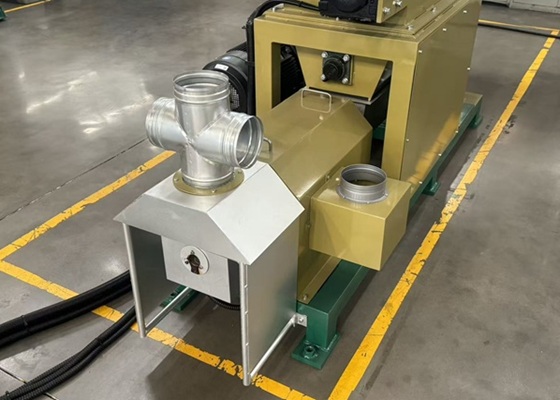
2. Professional Exhaust System to Improve the Working Environment
Although the test result shows that the odor does not affect human health or the environment, it may still influence the working experience in an actual workshop. Therefore, GreenMax further optimizes the equipment structure to guide and remove gases more effectively, reducing odor retention in the working area.
First, in the discharge area, gases tend to move along the sealed space toward the outlet. GreenMax can add an exhaust device at the discharge position and equip it with connection ports in different directions. This makes it easier for customers to connect exhaust ducts and direct the gases away from the workspace.
Second, the feeding inlet is also a common point where odor may escape. Since the feeding area is usually open and connected to the compression chamber below, some gas may flow back upward through the hopper.
To solve this issue, GreenMax can add a soft protective cover to the EPS densifier. This cover helps reduce gas backflow without affecting normal feeding. It can further improve the on-site polystyrene recycling environment. Another option is to install an exhaust duct above the feeding hopper to quickly remove gases and reduce odor leakage.
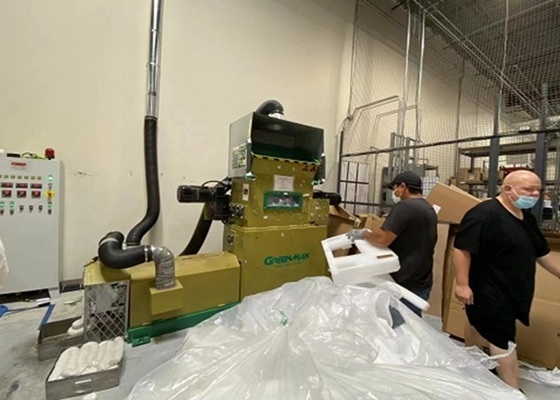
3. Activated Carbon Adsorption for Further Odor Reduction
For companies with higher environmental requirements, GreenMax can also add an activated carbon adsorption device. Activated carbon has a highly porous structure that can adsorb certain odor molecules and organic gases in the air, helping purify the air and reduce unwanted smells.
By combining the exhaust system with activated carbon adsorption, gases generated during the hot-melting process can be collected and treated more effectively. This helps customers reduce concerns about odor, workplace comfort, and environmental requirements.
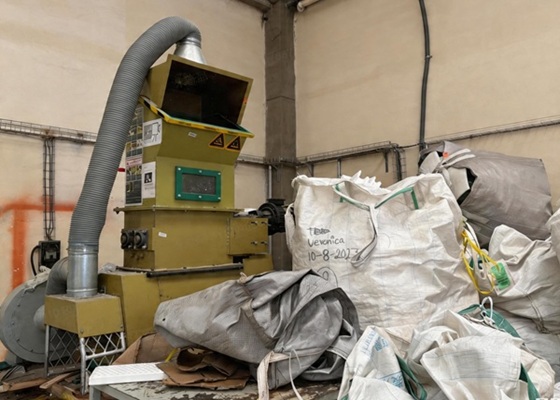
Overall, hot-melting foam volume reduction equipment remains an efficient choice for EPS foam recycling because of its high compression ratio, low maintenance cost, and wide material compatibility. It is not only suitable for EPS, but can also process EPE, EPP, and other foam materials, helping companies meet multiple recycling needs with one machine.
For customers who have delayed their recycling plans due to odor concerns, GreenMax provides a more complete and reassuring EPS recycling solution through three effective measures: SGS test reports, a professional exhaust system, and activated carbon adsorption.
With these solutions, GreenMax helps companies improve recycling efficiency while better balancing workplace conditions and environmental requirements.