
 Select Language
 English
 Spanish
 Polish
 Japanese
 Italian
 French
Is PE Trim Cutting into Your Profit? PE Foam Recycling Helps Packaging Converters Improve Order Margins
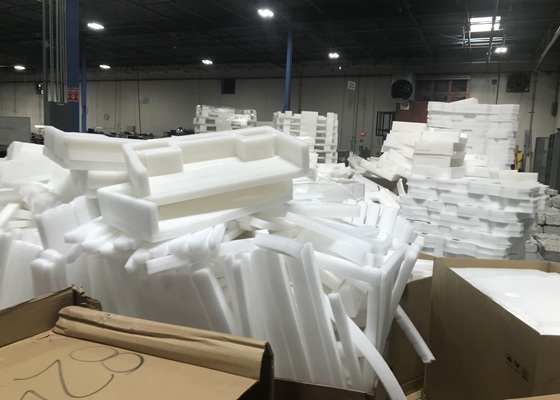
Walk into a PE foam packaging cutting facility serving solar, AI server, and electronics supply chains, and the first thing you often notice is not the finished packaging insert, but piles of EPE trim waste in the corner of the workshop.
To protect solar inverters, AI servers, electronic components, and other precision products, packaging converters need to cut, groove, punch, and shape full EPE sheets. This helps the packaging fit the product more closely and improves cushioning and shock protection. At the same time, it also creates a large amount of irregular edge strips, small pieces, and leftover material.
These trim scraps are usually difficult to reuse directly in new packaging production. They continue to pile up in the workshop or warehouse, taking up production space, affecting forklift traffic, and making site management more difficult. Once enough waste has accumulated, many companies still have to pay a third-party hauler to remove it.
For custom PE foam packaging converters, this has become a long-term cost pressure. In precision electronics and solar packaging projects, EPE trim waste can account for 20%–40% of the purchased material. In other words, for every 10 tons of PE raw material purchased, 2–4 tons may become difficult-to-reuse waste after cutting.
Why Does Trim Waste Affect Order Profit?
For PE foam packaging converters, trim waste is often seen as a “necessary loss.” In many factories, the common practice is simple: pile the trim waste in a corner of the workshop, wait until there is enough volume, and then pay a third-party recycler or hauler to take it away.
Over time, this creates a negative cycle: buy expensive PE material → generate large volumes of trim waste after cutting → pay to haul it away → buy new raw material again. This process repeats every month. Eventually, PE trim waste not only occupies space, but also becomes a hidden cost that quietly reduces the profit of every order.
For packaging manufacturers and foam cutting companies, handling PE foam trim in a more valuable way can reduce monthly hauling costs, improve net profit per order, and even create additional income through PE foam recycling.
Mature and Practical Recycling Solutions
EPE is a thermoplastic foam. Clean trim waste generated during the cutting process is usually free from contamination and can be reused after densification or pelletizing. For companies, polyethylene recycling is a practical way to turn a cost item into a revenue item.
There are two mature recycling solutions that packaging converters can consider based on their waste volume, investment plan, and expected recycling value:
1. Use a polyethylene foam densifier to compress loose trim waste into high-density blocks, which can then be sold to downstream recyclers or pelletizing companies.
2. Install pelletizing equipment in the factory to reprocess clean cutting waste into recycled pellets for internal blending or sale to downstream plastic manufacturers.
If your facility still pays to haul away large volumes of PE or EPS cutting waste, or if you want to understand the downstream sales channels for PE blocks and recycled pellets, please contact us through the WhatsApp link below. GREENMAX can provide a free recycling plan based on your daily waste volume.
Still paying to haul away PE or EPS cutting trim waste? GREENMAX can help turn it into compacted blocks or recycled material.
Solution 1: Polyethylene Foam Densifier — Compress Trim Waste and Sell It
Densification and volume reduction are often the first choice for small and medium-sized foam cutting companies. This solution is suitable for businesses that do not want to invest in a complex downstream system, but still want to reduce hauling costs and increase the value of their waste material.
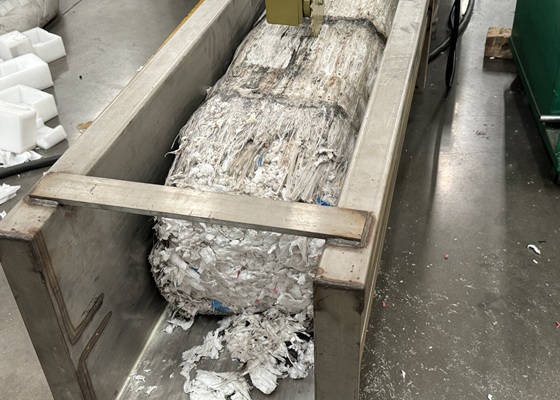
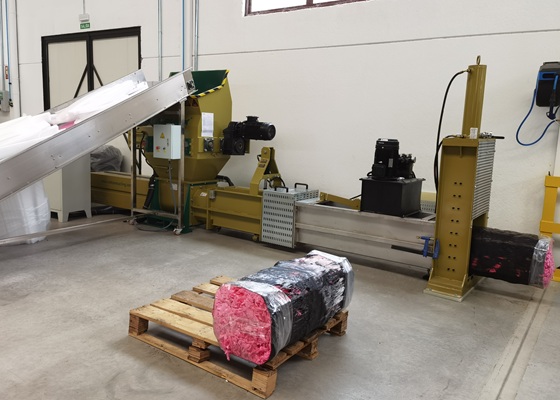
After densification, loose and bulky PE foam waste becomes regular, high-density rectangular blocks. These blocks can be stacked neatly on pallets, making storage, loading, and bulk sales much easier. With a compression ratio of up to 50:1, 100 cubic meters of loose foam can be reduced to about 2 cubic meters, freeing up nearly 98% of warehouse and workshop space.
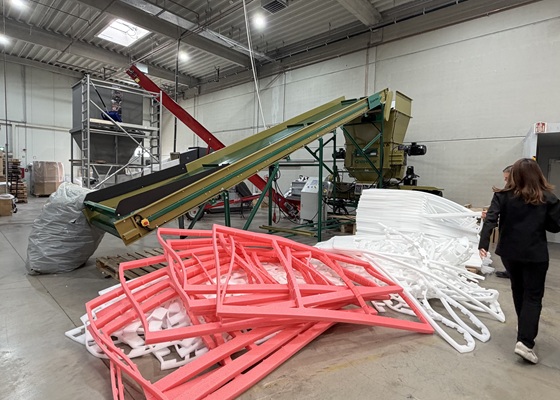
The GREENMAX polyethylene foam densifier first shreds foam trim waste into uniform pieces. The material is then continuously compressed by a screw system. At the discharge outlet, the surface of the compressed block is heat-fused to help maintain a stable shape. Compared with ordinary cold-press equipment, this EPE recycling machine keeps the advantage of low energy consumption while solving the rebound problem caused by the high elasticity of PE foam.
This PE foam recycling solution is easy to operate and does not require specialized technicians. A facility only needs one workshop operator to feed the trim waste regularly, stack the compressed blocks, and sell them to downstream recyclers or pelletizing plants once enough material has been collected. In many cases, the equipment investment can be recovered within 1–2 years.
Solution 2: Pelletizing Machine — Turn Waste Back into Raw Material
EPE trim waste generated during cutting is usually clean and free of impurities, making it highly suitable for pelletizing. This route can create greater recycling value.
Driven by European packaging regulations such as PPWR, recyclable and reusable packaging materials are becoming an important market trend. The proper use of recycled material is also increasingly accepted. Some large packaging companies, such as Sealed Air, have already started using recycled pellets to produce new PE packaging inserts.
After shredding, melting, and pelletizing, PE trim waste can be blended back with virgin material at a ratio of about 10%–20% for products such as cushioning pads, corner protectors, and other packaging components. In many applications, the performance can still meet practical packaging requirements. If the company does not use the recycled pellets internally, they can also be sold to downstream plastic manufacturers, usually at a higher value than compressed blocks.
GREENMAX has worked with a German packaging cutting company that adopted this polyethylene recycling solution. The factory first used a GREENMAX polyethylene foam densifier Z-C200 to process PE trim waste, then sent the material into a pelletizing system. The recycled pellets were eventually sold to the downstream market.
For companies like this, PE trim waste is no longer just production waste. It becomes a continuous source of raw material and additional revenue. At the same time, an in-house recycling system helps companies demonstrate ESG performance and closed-loop recycling capability, improving customer trust and competitiveness in new orders.
PE Trim Waste Should Not Be Only a Cost
For packaging manufacturers and foam cutting companies, PE foam trim waste cannot be completely avoided. But the way it is handled can be changed.
If companies continue to store it loosely and pay for hauling, trim waste will only keep adding costs. If it is compressed with a polyethylene foam densifier, the waste can become a stable source of recycling income. If it is further pelletized and reused, it can also reduce the purchase of new raw material and improve the overall profit margin.
As demand for packaging used in solar products, AI servers, and high-value electronics continues to grow, building a stable PE foam recycling process is no longer just an environmental choice. It is also an important way for packaging converters to control costs and improve order profitability.