 Select Language
 English
 Spanish
 Polish
 Japanese
 Italian
 French
One-Stop Transformation of Waste PET Bottles into High-Value Resources
Many beverages on the market, such as cola, use PET plastic bottles, a material well known for its recyclability.
Many beverage producers, distributors, and major retailers actively participate in PET bottle recycling—not only to meet environmental standards but also because PET bottles are a valuable recyclable resource.
However, for PET bottles to be truly reused as resources, they must go through a systematic processing procedure.
Step 1: Dewatering to Improve Recycling Quality
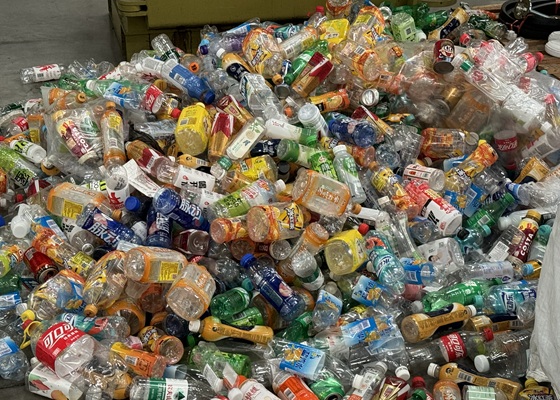
Many expired or defective beverage bottles from factories or supermarkets still contain a large amount of liquid, so the first step is filled bottle dewatering.
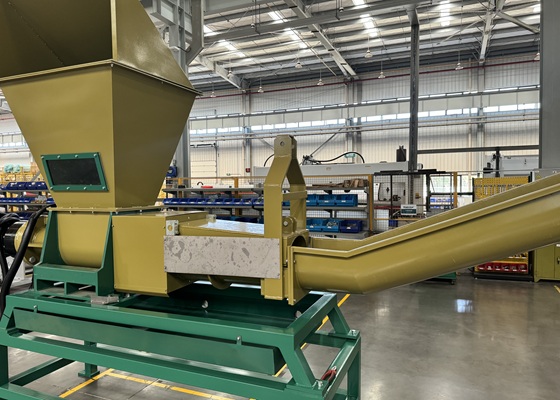
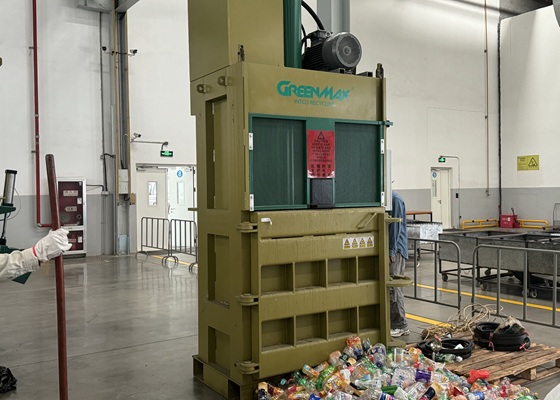
In the GreenMax PET bottles compactor, bottles are continuously compressed by a screw, and the liquid inside is discharged into a collection tray. The stainless-steel dewatering chamber is resistant to various low-pH liquids, ensuring corrosion resistance and long service life.
Through an upward-sloping discharge chute, any remaining liquid inside the PET bottles can be further drained. At the same time, the PET bottles compactor can automatically eject bottle caps during the dewatering process, improving overall efficiency.
Step 2: Label Removal to Increase Economic Value
If the bottles have already been emptied, the dewatering step with the PET bottles compactor can be skipped and go directly to label removal and compression.
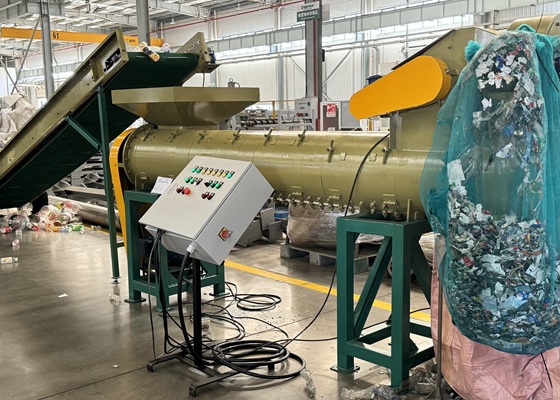
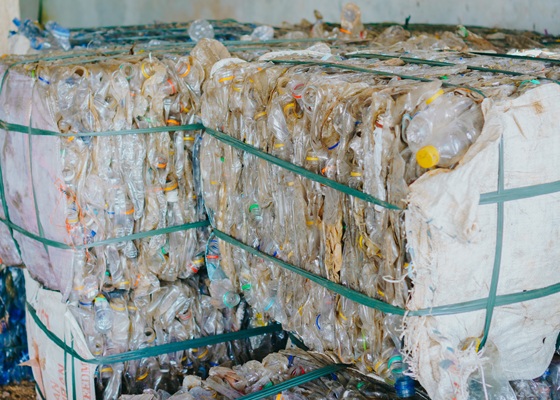
After dewatering, bottles first go through a label removing machine to strip off the labels, then a baler machine compresses them into high-density bales, greatly enhancing their economic value.
Compared with untreated plastic bottles, recycling plants prefer to purchase compressed PET bales that have been de-labeled and de-capped, and the sale price of PET bottle bales is much more favorable.
Step 3: Compression Molding to Improve Recycling Efficiency
GreenMax baler machine compresses collected bottles into high-density blocks weighing 300–500 kg, and a semi-automatic strapping system forms sturdy bales.
Through filled bottle dewatering, transportation costs in the PET bottle recycling process can be greatly reduced, while saving significant storage space. For example, 400 kg of PET bottles (cola-size) occupy about 27 m³ before compression, but only 2.5 m³ after—roughly the size of one and a half cartons.
For beverage manufacturers or recycling companies, adopting a one-stop system built with the GreenMax PET bottles compactor can significantly boost recycling efficiency and material quality, while also increasing the market value of PET bottle bales.
Step 4: Resource Regeneration to Create Green Value
The compressed PET bales have smaller volume, higher density, and strong market demand as a recyclable resource.
Compared with selling untreated waste bottles, dewatered, de-labeled, and compressed PET bales are clearly more competitive in the recycling market.
GreenMax can directly recycle these high-quality compacted bales, providing businesses with a convenient reuse channel and achieving a true “from waste to profit” green cycle.
GreenMax — A One-Stop Solution for PET Bottle Recycling
With a system combining the PET bottles compactor, label removing machine, and baler machine, GreenMax provides beverage manufacturers, supermarkets, and distribution centers with an efficient and eco-friendly PET bottle recycling solution.
It helps customers turn waste bottles into high-quality, marketable resources, reducing operating costs and creating sustainable economic value.