
 Select Language
 English
 Spanish
 Polish
 Japanese
 Italian
 French
Struggling with High-Density EPP Recycling (70–90kg/m³)? Here's the Solution
EPP (Expanded Polypropylene) is widely used in high-end packaging, automotive components, and electronic product protection. As its usage increases, recycling of EPP waste has become a growing concern for companies—especially for high-density foam (70–90 kg/m³), which is more challenging to process.
Challenges in High-Density EPP Recycling
• Stronger structure, harder to crush: High-density EPP is stiffer and more compression-resistant than standard EPS, making it difficult for conventional machines to process effectively.
• Higher material content per unit volume, heavier processing load: Each cubic meter of foam contains more actual material, requiring longer melting time and placing higher demands on equipment performance.
To address these challenges, GREENMAX has specially designed its polypropylene recycling machine, developing an EPP densifier with dual-stage shredding and equipped with water-cooling and drying systems to prevent operator risk from high-temperature melted blocks.
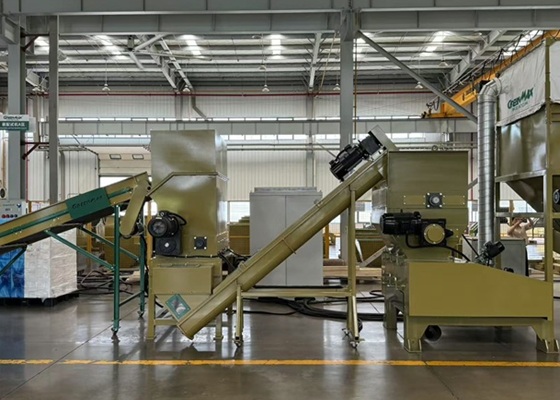
Dual-Stage Shredding Ensures Minimal Foam Particle Size
When handling high-density foam, two factors are critical: first, shredding EPP into sufficiently small particles; second, extending its residence time in the high-temperature compression chamber to ensure complete melting.
To achieve this, GREENMAX has equipped its polypropylene recycling machine with two shredders, each fitted with different filter mesh sizes. The first shredder uses a slightly larger mesh than the second, as a single-stage process cannot achieve the desired particle size.
Using only one shredder would limit the crushing effect and significantly increase processing time. Each shredder is also equipped with blades of different designs, ensuring the best possible outcome for EPP recycling.
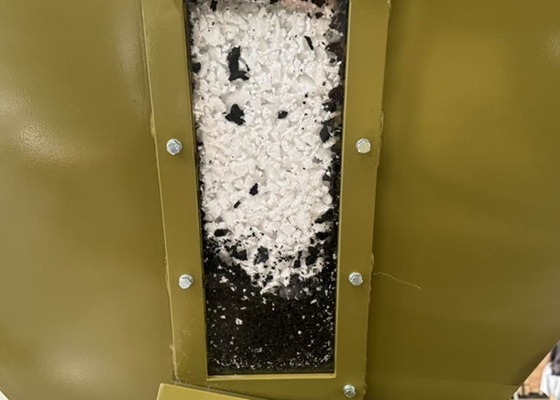
Finding the Optimal Balance Between Melting and Output
To fully melt EPP foam fragments, the ideal approach is to either extend their residence time in the high-temperature melting chamber or increase the chamber temperature.
Based on this, GREENMAX conducted in-depth research and identified the optimal balance between screw speed and output capacity, achieving both complete melting and high throughput.
Additionally, the discharge outlet of the EPP densifier can be extended to further increase the material's residence time in the chamber.
The GREENMAX polypropylene recycling machine is also equipped with a three-stage temperature control system, which effectively prevents temperature drops caused by moisture evaporation, ensuring the stability and performance of expanded polypropylene recycling.
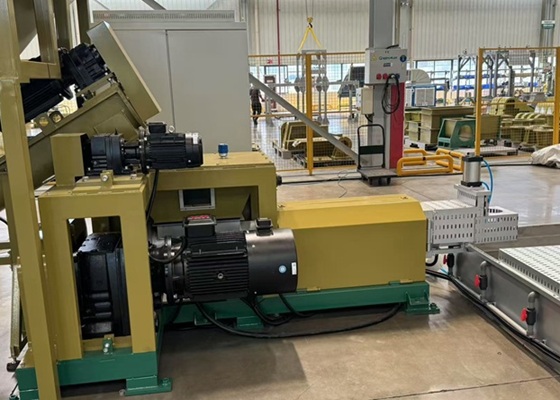
On-Site Test for High-Density EPP Recycling
GREENMAX conducted an initial test using EPP foam with a density of 70 kg/m³ and EPO foam of 60 kg/m³. During the test, two shredders processed the foam into particles of approximately 20–40 mm.
The thermal melting system was configured with three-stage temperature control, set at 220 °C, 220 °C, and 200 °C, completely melting the foam into dense blocks with a volume reduction ratio of up to 90:1.
In addition, the EPP densifier is equipped with an automatic cutting system and a water-cooling and drying system:
the molten EPP is cut into smaller pieces and automatically fed into a water ring system for cooling, ensuring operational safety. Then it passes through the drying system and falls into a storage bag, completing a fully automated EPP recycling process.
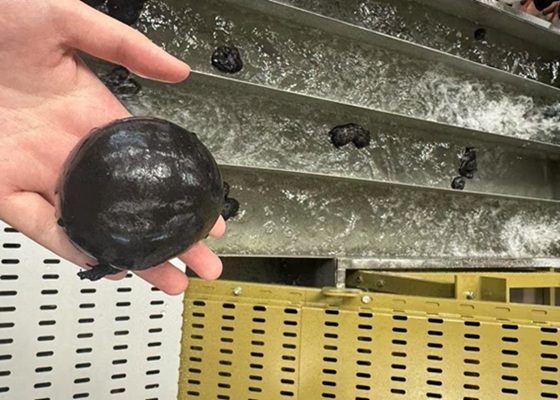
If you're also facing challenges with high-density expanded polypropylene recycling, feel free to contact GREENMAX for a customized solution.