 Select Language
 English
 Spanish
 Polish
 Japanese
 Italian
 French
Why Plan for Polyethylene Recycling Before the PPWR Fully Applies?
The EU’s new Packaging and Packaging Waste Regulation (PPWR) entered into force on February 11, 2025, and will generally apply from August 12, 2026. The regulation covers all packaging and packaging waste, and it introduces recyclability requirements for all packaging placed on the EU market. Among these requirements, the standard that packaging must be capable of being collected, sorted, and recycled at scale will take effect starting in 2035.
On March 30, 2026, the European Commission published PPWR guidance and FAQs, focusing mainly on the definition of packaging, responsible parties, recyclability and reusability requirements, restrictions on single-use packaging, Extended Producer Responsibility (EPR), and related topics. This means companies can no longer focus only on packaging performance. They also need to think much earlier about how packaging waste will actually be collected and recycled in practice.
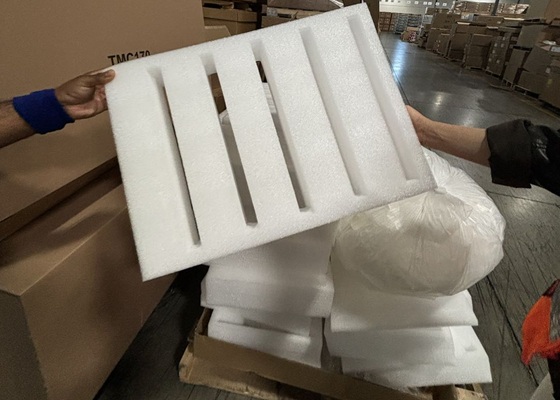
PE foam is widely used in electronics, furniture protection, and automotive parts packaging. Common examples include corner protectors for furniture and cushioning pads used in parts handling and transport. Companies choose this material because it is lightweight and provides reliable cushioning performance. Because it is used so broadly, appliance distribution centers and automotive parts assembly plants continue to generate large volumes of post-use PE foam packaging waste.
For these businesses, polyethylene recycling is no longer something to think about “later.” It is now a practical need to establish a workable recycling path as soon as possible. Landfilling is no longer a sustainable long-term option, and it will likely face increasing policy restrictions in the future. Recycling is the clearer direction going forward.
At present, PE foam recycling is already a relatively mature process and can generally be divided into two main stages: densification and pelletizing. Densification is mainly used to solve the on-site problem of bulky foam waste, improve warehouse space utilization, and make transportation easier while lowering logistics costs per unit. Downstream recyclers then purchase the densified PE foam and process it further through pelletizing to produce recycled resin pellets, which can be sold to polyethylene product manufacturers.
Densification: Solving the Volume Problem
Today, there are two common ways to reduce the volume of PE foam packaging waste: shredding and compressing.
1. Shredding
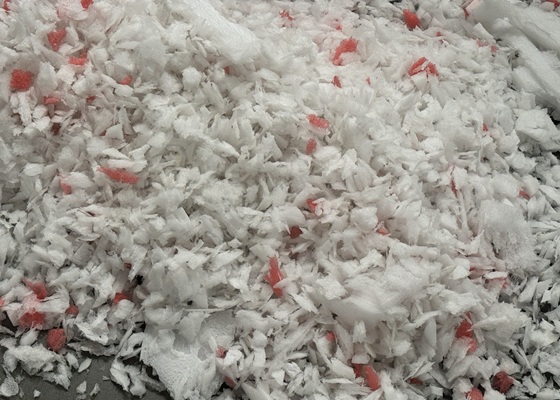
Using sharp spiral blades, a foam crusher can shred packaging waste into fairly uniform pieces of about 1.2 to 2 inches. To make the particle size more consistent, the machine is usually fitted with a screen inside. Pieces that meet the size requirement are discharged directly from the outlet and collected in bags, while larger pieces of PE foam are returned to the crushing chamber for further processing.
This method mainly addresses the problem of foam being too bulky and irregular. It turns loose, messy material into baggable pieces that are easier to handle and store. However, the overall volume reduction is still relatively limited.
2. Compressing
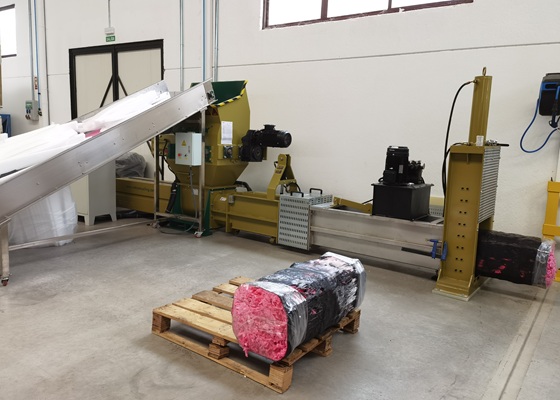
By comparison, compression targets the volume issue more directly and can usually achieve high densification ratios such as 50:1 or even 90:1. A PE foam densifier uses screw extrusion combined with surface heat treatment to shape the material into dense blocks, or it may use high-temperature melt extrusion directly to transform loose foam into compact output.
These compressed blocks can be stacked directly on pallets and secured with stretch film, making them much easier to load, transport, and sell.
This approach solves the storage problem more thoroughly by turning bulky foam waste into neat, dense blocks. That is why it has become one of the more commonly used polyethylene recycling methods for logistics centers and automotive parts assembly plants.
Pelletizing: Turning Foam Back into Raw Material
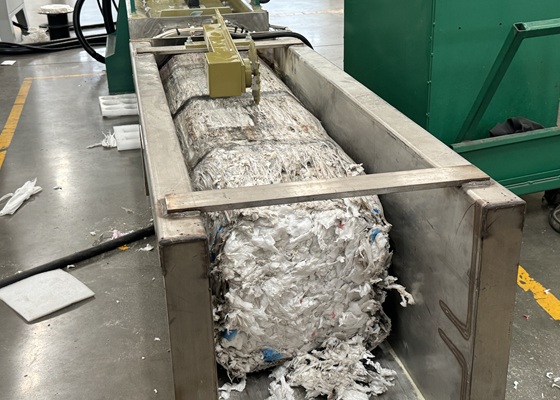
If the compressed foam is to be further processed into recycled material that can go straight back into manufacturing, it must enter the pelletizing stage. After entering a EPE recycling machine or PE foam pelletizer, the material is continuously broken down, melted into a flowable state at high temperature, and passed through a filter screen to remove impurities. It is then formed into long strands, cooled through a water-cooling system, and cut into uniform pellets.
These recycled PE foam pellets can be used again in the production of packaging materials, pads, and other polyethylene products.
For companies with a stable supply of waste material and a desire to increase material value, PE foam recycling is not just about waste handling. It is also a way to turn packaging waste back into usable raw material. Especially as policies such as the PPWR continue to push packaging toward recyclability and circular use, businesses need to start planning polyethylene recycling early.

How Should Appliance Distribution Centers and Automotive Parts Assembly Plants Choose?
For these facilities, the core goals are usually the same: handle packaging waste in a more environmentally responsible way, solve the problem of PE foam accumulation, reduce current disposal costs, and recover at least some value from the waste stream. In most cases, volume reduction alone is already enough, which means choosing between shredding and compression.
A foam crusher usually requires a lower upfront investment, so it is often a better fit for operations dealing with mixed material shapes or those that first want to turn sheets, edge trim, and offcuts into a more uniform form. However, its effect on reducing transportation volume is relatively limited.
In contrast, the main advantage of a PE foam densifier is much greater volume reduction. It is better suited for companies with larger and more stable waste volumes, higher pressure on storage and transportation, and plans to sell material or expand their recycling business in the future. Of course, this type of equipment generally requires a higher investment and more maintenance.
In simple terms, if your waste is scattered and your budget is limited, shredding may be the better first step. If your waste stream is stable and you want to improve transportation efficiency and resale value, compression is usually the better choice.