 Select Language
 English
 Spanish
 Polish
 Japanese
 Italian
 French
XPS Foam Recycling | Two Solutions for Job Sites and Building Material Distributors
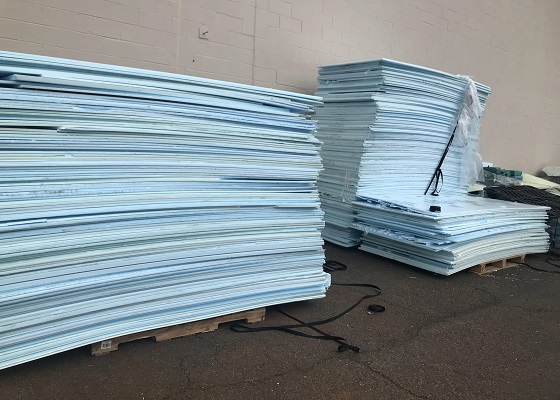
In commercial roofing projects, cold storage and warehouse renovations, residential energy-efficiency upgrades, building material distribution centers, and insulation board warehouses, large volumes of blue, pink, or green XPS foam board scrap are often generated. These include cut-off pieces, opening cuts, damaged boards from transportation, and returned materials.
Today, many contractors and distributors still throw these materials directly into a C&D dumpster, paying for hauling, container rental, and landfill tipping fees. Since XPS is lightweight but bulky, dumpsters fill up quickly, which increases container swaps and transportation costs.
This approach is not cost-effective. Many newer XPS insulation boards in North America have moved away from HBCD-based flame retardants. Clean XPS scrap from new construction, warehousing, or distribution, if free from dirt, glue, roofing membrane, and other contamination, is often more suitable for separate collection and compaction rather than being treated as ordinary construction waste. For older demolition materials, project year and local disposal requirements should be checked first.
In other words, companies are paying to dispose of clean XPS foam board, while recyclers need clean, dry, and compacted foam material. What is missing is a practical Styrofoam recycling process that can be implemented on site or in the warehouse.
Policy and Market Factors Are Driving XPS Foam Recycling
In the U.S., XPS foam recycling is influenced by state and local C&D waste management requirements, landfill tipping fees, green building project expectations, and companies’ need to reduce operating costs. For clean XPS scrap generated from new construction and warehouse operations, separate collection and compaction are usually more valuable than direct disposal in a C&D dumpster.
At the same time, plastic recyclers and insulation-related manufacturers still have demand for clean, dry, and single-material polystyrene foam waste. After compaction, shredding, and pelletizing, XPS and EPS scrap can re-enter applications such as plastic products, lower-grade insulation materials, building accessories, and plastic profiles.
Therefore, in the U.S. market, the main driver for construction foam recycling is not only regulation, but three practical business needs: reducing C&D waste hauling costs, improving storage and transportation efficiency, and turning clean foam scrap into a recyclable material with resale value.
Two Styrofoam Recycling Solutions: Mobile and Fixed Scenarios
Clean XPS waste in the construction and building material supply chain can generally be divided into two categories.
The first category is cutting scrap generated directly on job sites, such as commercial roofing projects, exterior insulation work, solar roof insulation installation, cold storage construction, and residential energy upgrades. This type of waste is scattered across multiple job sites and is better suited for a mobile XPS foam densifier. Scrap produced during the day can be compacted the same day, reducing on-site storage pressure and preventing lightweight XPS pieces from being blown around the job site.
The second category is clean board loss generated in fixed locations, mainly from building material distributors, insulation board manufacturers, and warehouse centers. This includes boards damaged during transportation, customer returns, inventory loss, and production cutting scrap. Since the material flow is more stable and concentrated, a fixed machine installed in a warehouse or plant corner is usually more efficient.
For large building material and insulation distributors, monthly XPS losses from transportation damage and returns can reach several tons. In the past, these materials were often treated as operating costs. Through XPS foam recycling, the scrap can be compacted and sold to downstream recyclers or material processors, helping turn a cost item into a potential revenue stream.
Have XPS foam board scrap from job sites or warehouses? Tell us your material volume, and GREENMAX will recommend the right XPS foam densifier solution.
GREENMAX Mars Foam Compactor: Efficient Volume Reduction for XPS Waste
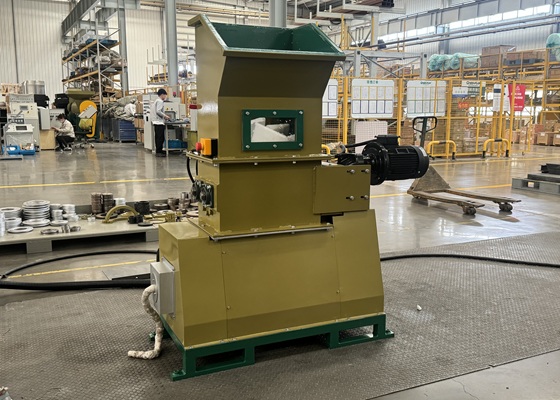
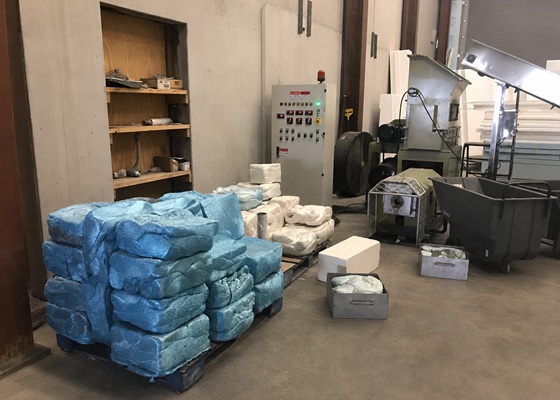
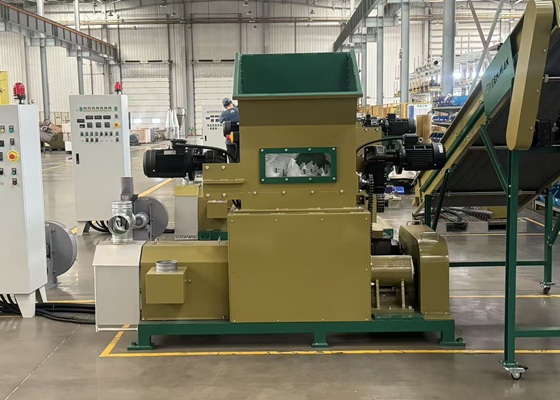
For XPS scrap treatment, the GREENMAX Mars series foam compactor uses hot-melt densification technology to reduce loose XPS offcuts and damaged boards to about 1/90 of their original volume. The output is a dense, uniform block that is easier to store, transport, and sell to downstream recycling companies.
The machine is easy to operate. Basic operation can be completed through start/stop buttons and temperature control buttons. After simple training, recycling truck drivers, warehouse workers, or ordinary job-site operators can use the equipment without difficulty.
For mobile recycling scenarios, the compact M-C50 XPS foam densifier is recommended. With a small footprint, it can be placed on a pickup truck or trailer and moved between different job sites for “collect and densify” service. It is especially suitable for recyclers serving multiple construction sites or contractors handling dispersed foam waste.
For fixed scenarios such as distributor warehouses, insulation board plants, and storage centers, the standard M-C100 or M-C200 models are recommended. These machines can be installed in a warehouse corner to continuously process damaged boards and inventory loss. In daily operation, one worker can feed the machine part-time, meeting stable waste handling needs while supporting long-term Styrofoam recycling requirements.
XPS Waste Should Not Be Just a Hauling Cost
With the continued growth of energy-efficient buildings, solar roofing, cold storage construction, and circular material management in the United States, clean XPS waste should not simply be treated as ordinary trash. For contractors, insulation manufacturers, and building material distributors, building an XPS foam recycling process and using an XPS foam densifier for volume reduction can reduce storage pressure, lower hauling costs, and improve the value of recovered foam material.
XPS scrap cannot be completely avoided, but the way it is handled can change. Companies that complete sorting, compaction, and recycling earlier can gain a more stable advantage in cost control, warehouse management, and material recovery.