
 Select Language
 English
 Spanish
 Polish
 Japanese
 Italian
 French
EPP Packaging Waste Recycling for Automotive Parts Suppliers
EPP packaging is widely used to protect bumpers, interior trim, electronic modules, battery components and other automotive parts in transit. Depending on the product, it may take the form of molded trays, box liners, corner protectors or custom inserts. This packaging can become waste for several reasons. Some trays are damaged during handling, while others are retired when a vehicle programme or part design changes. EPP manufacturers also generate offcuts and rejected molded parts during production.
Once the packaging can no longer be reused, its volume becomes the main concern. EPP is light, strong and highly elastic. It keeps its shape under pressure and quickly rebounds, taking up warehouse space while adding little weight to each collection load.
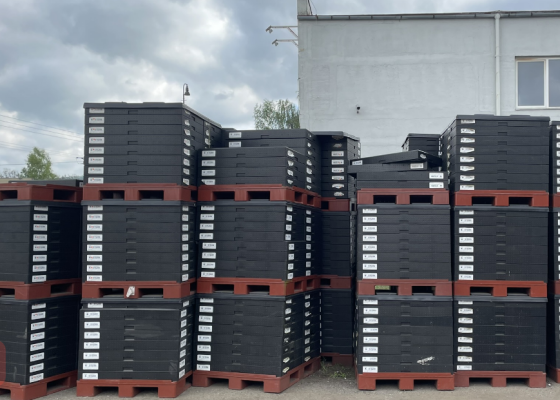
Sending loose EPP over long distances is usually expensive because most of the load is air. Crushing and compacting the packaging reduces the space it occupies and allows more material to be carried in each shipment.
The packaging first passes through a crusher, which breaks the molded parts into smaller pieces. A screw then compresses the material into dense blocks. As EPP varies in density and rigidity, the crusher, screw speed and discharge settings should be matched to the packaging being processed. The finished blocks are easier to stack, store and transport to a recycling facility. Compaction is not the final recycling stage, but it makes the next steps far more economical.
GREENMAX EPP Compactor Used by a Czech Recycler
A recycling company in the Czech Republic handles around 20 tons of industrial foam waste each month. About half of this volume is EPP packaging collected from automotive parts suppliers. The incoming material includes molded trays and protective inserts with densities ranging from approximately 40 to 70 kg/m³. Stored loose, these items occupied considerable space and were expensive to transport. The recycler wanted to turn them into compact blocks that could be accepted by buyers in the local recycled-material market.
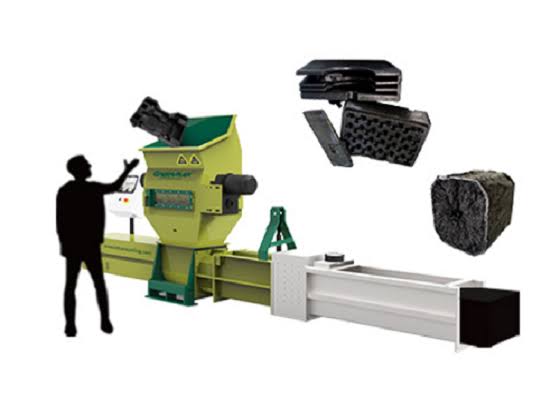
GREENMAX foam compactor Z-C200 was used to dispose EPP foam waste. The crusher was equipped with two reinforced 5.5 kW motors to process the resilient packaging. Variable-frequency control was also added so that the operator could adjust the main screw speed for different batches. This flexibility is useful when automotive packaging varies in thickness, shape and density. Instead of processing every load at the same setting, the operator can adjust the machine according to the material entering the line.The compacted EPP comes out as dense blocks that take up far less space and are easier to load and transport.
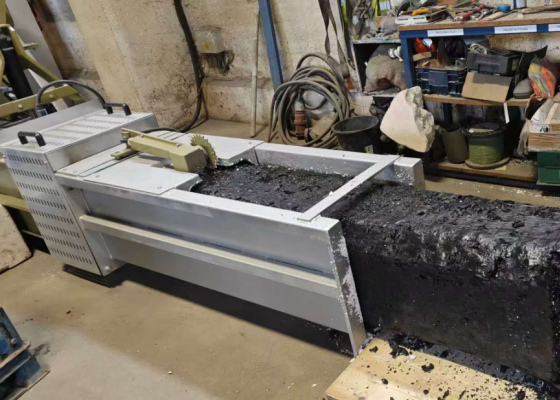
Recycling Compacted EPP Blocks
After transportation to a specialist facility, the EPP blocks can be shredded, extruded and pelletized. The recycled polypropylene can then be used as raw material for suitable plastic products, depending on its quality and the manufacturer’s requirements. Automotive parts suppliers do not necessarily need to manage every stage themselves. A business producing moderate volumes may send its packaging to a regional recycler, while a larger plant or collection centre may compact the EPP before shipment.
The right arrangement depends on how much EPP is generated, how much storage space is available, the distance to the recycler and the type of material the buyer accepts. Before choosing equipment for EPP foam recycling, it is useful to provide samples along with the typical packaging dimensions and monthly waste volume.
FAQ
1. Can automotive EPP packaging be recycled?
Yes. Used EPP trays, liners and protective inserts can be crushed, compacted and processed into recycled polypropylene material, provided a suitable downstream recycling route is available.
2. Why does EPP require a suitable foam compactor
EPP is resilient and tends to rebound after pressure. Its density and shape affect the crushing load, screw speed and the stability of the compacted blocks.
3. Should an automotive supplier compact EPP onsite?
Onsite compaction is more suitable when EPP is generated regularly and loose packaging creates high storage or transport costs. Smaller suppliers may find it more practical to send the material to a regional recycler.