 Select Language
 English
 Spanish
 Polish
 Japanese
 Italian
 French
GREENMAX Foam Densifier: Built for High-Volume Styrofoam Recycling Operations
Walk into a recycling yard that handles Styrofoam and you'll usually spot the same thing: a mountain of foam that keeps growing faster than anyone can haul it away. It's not that the material is heavy. It's that there's so much of it, and almost all of that volume is air.
That's the point where a cold press stops being enough. The blocks come out too light, trucks fill up long before they reach their weight limit, and buyers aren't willing to pay much for material that's bulky and inconsistent. A foam densifier changes the equation by melting the foam down and pressing it into dense ingots that travel and sell like a real commodity. That's GREENMAX densifiers are built for. When foam arrives every day and never really stops, every bit of volume you remove is money you don't spend on trucks and floor space.
When Foam Piles Up Faster Than You Can Move It
Small machines make sense when the foam comes in slowly. Once a recycling operation grows, the same equipment quietly turns into a bottleneck. Foam sits in the yard waiting its turn, trucks make extra runs, and staff spend more time shuffling material than processing it.
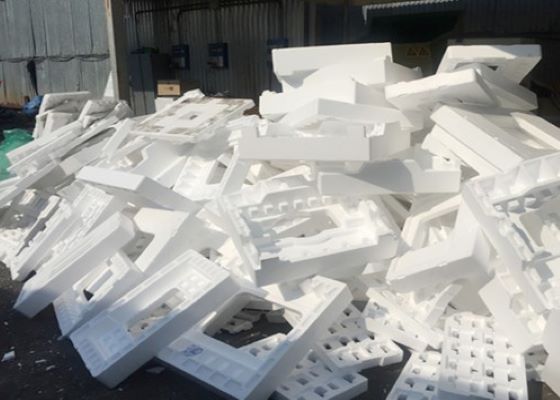
What usually gives out first isn't weight capacity, it's floor space. A machine can be running well within its rated tonnage and the site still feels overwhelmed, because Styrofoam is roughly 98% air. Storage areas fill up, collection days pile on top of each other, and the operation starts to lose the efficiency it was built for.
Producer Improved Styrofoam Recycling with Foam Densifiers
Expol is the largest polystyrene producer in New Zealand, with seven factories, and close to 100 public drop-off points around the country. Roughly 30% of its polystyrene goes back into products like foam foundations, and its drainage panels are made entirely from recycled material.
Even with all of that in place, the company's cold press equipment couldn't keep up with the volume coming through the door. The blocks it produced weren't dense enough, which meant higher transport costs and lower prices when the material was sold on.
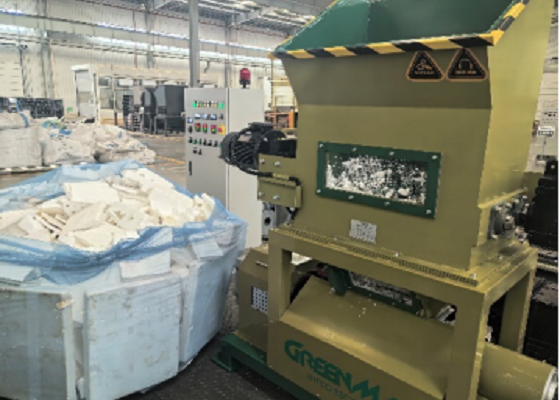
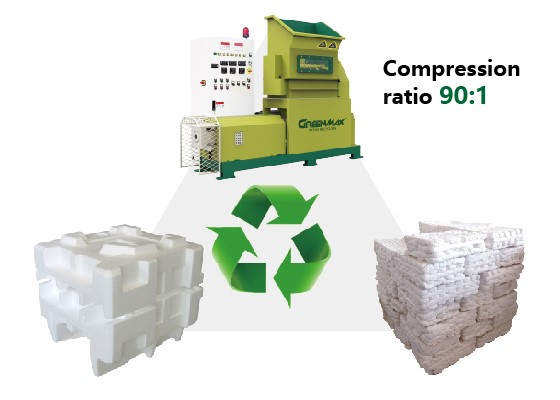
Expol brought in two GREENMAX machines - foam densifier M-C100 and foam densifier M-C200 - both using hot-melt technology with a compression ratio of up to 90:1. The denser blocks were cheaper to ship and worth more to buyers, and the whole recycling line ran more smoothly as a result.
Picking Foam Densifier That Keeps Up
There's more to choosing a densifier than looking at the throughput figure on a spec sheet. What matters is how the foam actually behaves at your site: whether it comes in large molded panels or small loose pieces, how many hours a day you can run the machine, and how much floor space you're willing to give up.
Foam from food or marine operations often carries moisture and residue, which changes both the process and the maintenance routine. Mixed grades usually need sorting beforehand. And if the ingots are heading to a granulator, cleanliness and consistency will matter more to your buyer than raw speed. It also pays to plan for growth instead of today's volume. Once collection becomes routine, volumes tend to rise — and a machine sized only for current tonnage can hit its ceiling within a couple of years.
For operations where foam just keeps coming, GREENMAX foam densifier keeps the material moving. Denser ingots mean cheaper transport, tidier storage, and more value at the next stage of recycling.