 Select Language
 English
 Spanish
 Polish
 Japanese
 Italian
 French
How Seafood Businesses Can Build a Daily “Unbox-and-Recycle” System for EPS Fish Boxes
1. Feed used fish boxes into the EPS compactor;
2. remove the compacted EPS blocks and stack them neatly on pallets;
3. sell the compacted material to downstream recyclers.
For many seafood businesses, this can become part of the daily waste-handling routine. Bulky piles of EPS fish boxes can be reduced in volume by up to 50:1 and then sold to recyclers. In addition to their core seafood business, selling compacted EPS can also create an ongoing recycling return.
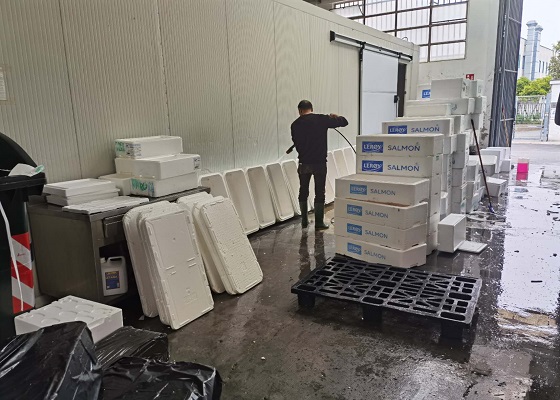
EPS fish boxes are not simply waste that appears after the seafood is sold. They are generated continuously during receiving, sorting, and distribution. If loose boxes are left behind cold-storage areas or loading docks, they quickly take up space and may develop odors from heat, sunlight, moisture, and organic residue. Waiting until a large pile builds up before calling a recycler can also make the worksite harder to manage.
Why should EPS fish boxes be compacted before transportation?
EPS fish boxes are extremely lightweight but very bulky. Just a few dozen loose boxes can fill a cage cart or a large portion of a truck while adding very little actual weight. During direct hauling, the vehicle often runs out of space long before reaching a practical payload, resulting in poor loading efficiency and higher transportation costs.
Used fish boxes also tend to retain moisture and may drip during storage and transportation. This creates additional cleanup work and may affect whether downstream recyclers accept the material and how they price it.
For seafood businesses, a more practical approach toStyrofoam recycling is therefore to compact loose fish boxes first, turning them into denser, more stable material that is easier to store, load, and transport.
How does a cold-press EPS compactor process fish boxes?
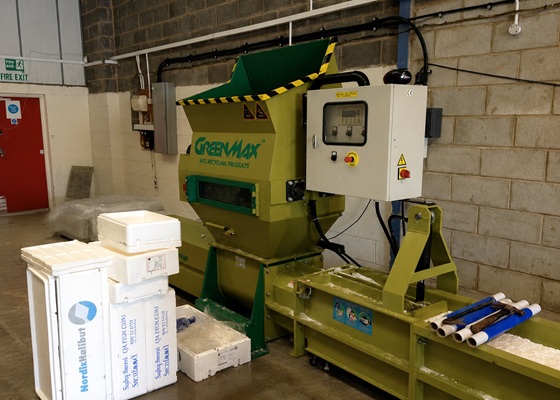
When fish box volumes are relatively consistent, GREENMAX recommends building volume reduction and compaction into a continuous EPS recycling process rather than relying on a standalone foam compactor alone.
1. Screw crushing and compression: better suited for wet fish boxes
Unlike relatively dry EPS packaging from appliances or electronics, fish boxes often contain residual moisture. For this reason, cold compression is generally more suitable for wet EPS than direct high-temperature melting.
After entering the machine, the fish boxes are first crushed and then continuously compressed by a screw into high-density blocks, with volume reduction of up to 50:1. Because the process does not rely on fully melting the EPS, residual moisture has less impact on block formation, making it well suited for seafood markets and fish distribution centers.
Screw-based physical compression also has relatively low energy demand. In a typical setup, processing about one metric ton of fish boxes may require around 10 hours of operation, with machine power of approximately 10 kW.
2. Automatic cutter: consistent block sizes with less manual work
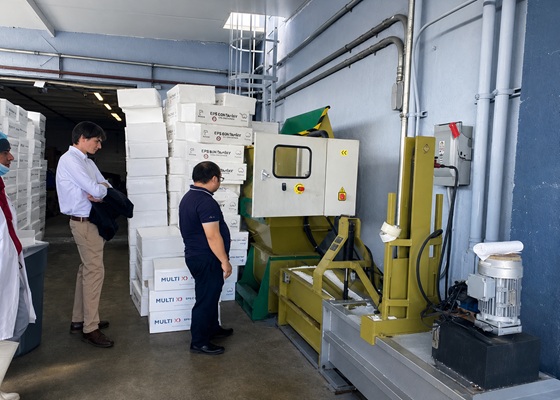
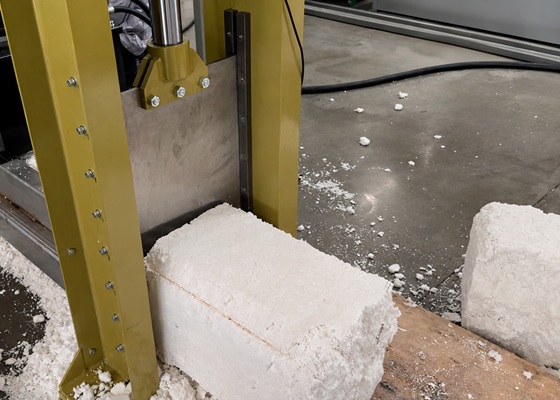
During continuous compression, EPS exits the machine as a long compacted section. An automatic cutter can divide the material at a preset length, creating more uniform blocks that are easier to handle and transport.
This reduces manual cutting while making the blocks easier to palletize, load, and deliver to recyclers. For businesses processing fish boxes every day, removing one repetitive task can make the overall Styrofoam recycling process simpler and less labor-intensive.
3. Water-cooling system: temperature control for stable operation
Continuous screw compression generates friction heat. If the temperature becomes too high, the EPS may soften excessively and affect material feeding and machine operation.
The water-cooling system helps control the temperature in the compression area, allowing the EPS compactor to operate more steadily during longer production runs. Its purpose is not to wash the fish boxes, but to manage friction heat and reduce unnecessary thermal stress on the equipment.
GREENMAX customizes the fish box recycling solution
Not every seafood business generates the same type of EPS fish box. Some seafood markets produce moderate volumes with high moisture levels, while seafood processors serving export markets may use much larger boxes. Professional recyclers may also collect EPS packaging from ports, seafood markets, supermarkets, and distribution centers.
GREENMAX therefore does not select equipment based only on the material being “fish boxes.” Instead, the solution is matched according to daily EPS volume, moisture level, contamination, box dimensions, operating hours, and downstream recycling requirements.
For wetter fish boxes, screw compression is usually more suitable than direct hot melting. If the material is heavily contaminated and needs better cleaning, additional washing and drying stages can be added before compaction.
GREENMAX has supplied an integrated EPS washing and compaction system to a customer in Italy. The system cleans contaminated EPS packaging before cold compression, helping prepare cleaner material for downstream recycling.
Watch the factory test video of this GREENMAX system below:
For businesses handling seafood packaging every day, an efficient Styrofoam recycling system is not about adding more labor. It is about letting equipment handle repetitive work. By combining a cold-press EPS compactor, automatic cutting, and water cooling, bulky fish boxes can be transformed from loose waste beside the cold-storage area into compact, organized, and recyclable material ready for the next step.