 Select Language
 English
 Spanish
 Polish
 Japanese
 Italian
 French
How to Choose a PE Foam Densifier: Cold Compaction, Hot Melting, and Capacity Guide
First, Identify the Main Problem: Storage Space or Material Reuse?
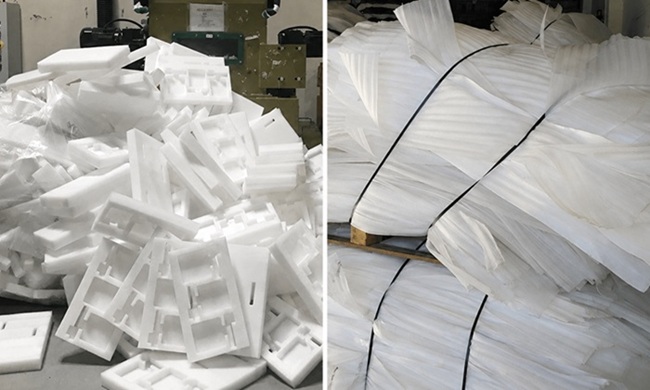
EPE foam is widely used to protect electronics, appliances, furniture, automotive parts, and industrial equipment. After unpacking, companies typically face two common problems:
· EPE foam continues to accumulate, taking up warehouse space and blocking production aisles.
· The waste is lightweight and irregularly shaped, resulting in poor storage efficiency and high transportation costs.
For this reason, choosing a PE foam densifier should not be based only on the volume-reduction ratio. Companies should first answer three questions:
1. What type of EPE waste is generated: thick protective packaging from electronics or furniture, or soft and lightweight EPE sheets?
2. How much waste is produced each month: 10 m³, 50 m³, or more than 100 m³?
3. Will the densified material be sold directly or sent for downstream pelletizing?
Different answers require different equipment configurations. Large and thick foam pieces may require a customized or upgraded shredding system. Soft EPE sheets may bridge inside the hopper or cause feeding blockages, so the feeding structure must also be evaluated carefully.
In many applications, stable and continuous feeding is more important than simply choosing a machine with a larger motor.
APOLO Cold-Compaction System: For Material Quality and Downstream Pelletizing
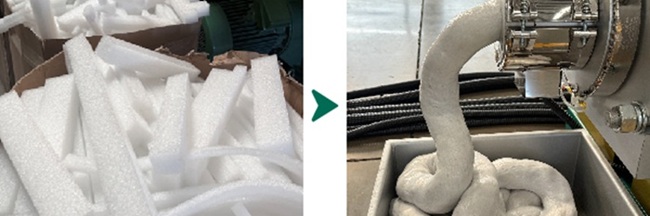
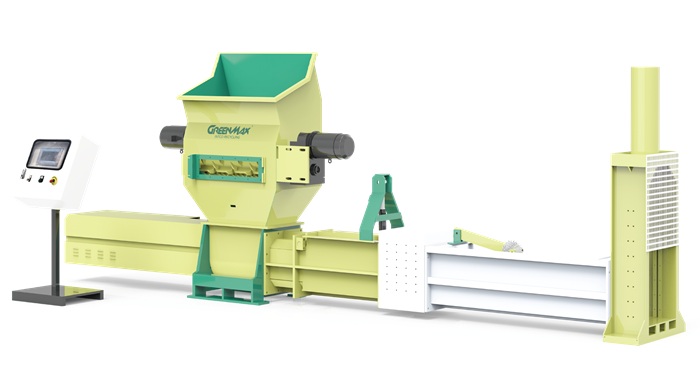
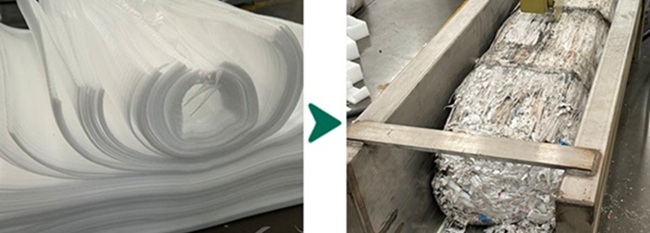
The cold-compaction EPE recycling machine first shreds loose EPE foam and then compresses it into dense blocks through screw extrusion. At the discharge outlet, a surface-melting stabilization unit lightly heats the outer layer of the block, helping it maintain a stable shape. The system can achieve a volume reduction of approximately 50:1.
A cold-compaction polyethylene recycling solution is more suitable when:
- The EPE waste is relatively clean and comes from a consistent source.
- Downstream buyers want the original material properties to remain largely unchanged.
- The compacted blocks will later enter a pelletizing process.
- The company has strict requirements for odor, temperature, and the workplace environment.
- The foam has a relatively high density and is better suited to cold-compaction PE foam recycling.
Because PE foam has natural elasticity, blocks produced by a conventional cold compactor may gradually loosen or lose their shape. With the added surface-melting function, the outside of the block is lightly melted and quickly solidified, securely holding the foam pieces inside and reducing loose fragments.
The process still relies mainly on mechanical compression. Only the outer surface is stabilized, while the material inside is not completely melted. As a result, the material properties are changed less, which is more favorable for downstream pelletizing and reuse.
MARS Hot-Melt System: For Greater Volume Reduction and Easier Operation
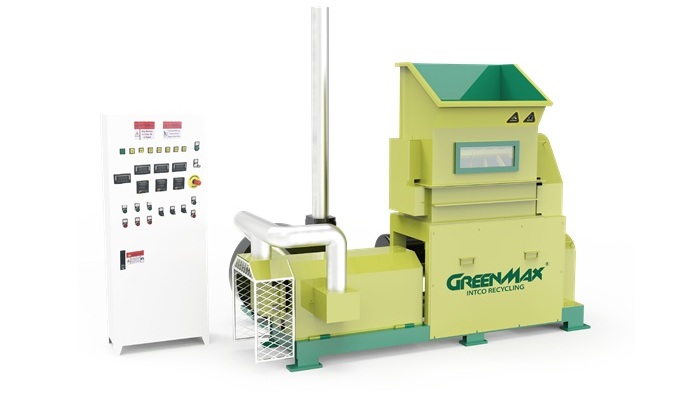
A hot-melt PE foam densifier uses controlled heating and screw extrusion to melt loose EPE foam and form stable, high-density blocks. The system can achieve a volume reduction of approximately 90:1.
A hot-melt solution is more suitable when:
- Large volumes of EPE waste quickly fill the warehouse.
- The material must be transported over long distances or shipped in consolidated loads.
- Downstream buyers prefer high-density melted blocks, or the company wants to improve container-loading efficiency.
- Operators change frequently and the equipment must be easy for new employees to learn.
- The company wants a highly automated recycling system with less manual handling.
A hot-melt EPE recycling machine offers relatively simple operation, lower dependence on manual labor, stable block formation, and significant volume reduction. The shredding system first processes the PE foam into relatively uniform pieces. The material then enters the melting chamber, where it is heated, compressed by the screw, and continuously discharged in a semi-molten state.
The equipment uses three independently controlled heating zones. The temperature of each section can be adjusted separately to maintain stable melting and extrusion of EPE foam.
The hot-melt process can also reduce some moisture and loose contaminants in the material. However, it cannot replace front-end sorting. Tape, metal, and other types of plastic should still be removed before processing.
How Should the Capacity of a PE Foam Densifier Be Selected?
A larger machine is not always the better choice. The capacity should match the rate at which waste is generated, the planned operating time, and the available labor for feeding the equipment.
Waste volume can be used for an initial capacity estimate, but additional capacity should also be reserved for seasonal peaks, order fluctuations, and concentrated feeding periods. GREENMAX can recommend a suitable machine based on the type of EPE waste and the volume generated each week.
Before selecting a machine, confirm the following:
· How many cubic meters, bags, or pallets of EPE waste are generated each day?
· Is the waste generated continuously or concentrated during certain periods?
· How many hours will the equipment operate each day or week?
· Does all daily waste need to be processed within one shift?
· Can employees continuously unpack, sort, and feed the material?
Small machines are suitable for companies with one production line, limited waste volume, periodic batch processing, or restricted floor space.
Standard machines are suitable for facilities that generate EPE waste every day and want to complete processing within one work shift.
Large automated systems are more appropriate when several production lines generate waste at the same time, manual feeding is difficult, or the company needs to connect a shredder, storage silo, densifier, and automatic discharge system.
An undersized machine may allow waste to continue accumulating during peak periods. An oversized machine may frequently run empty if the facility cannot provide a steady material supply. The right EPE recycling machine should process the required waste volume within the planned operating time while matching the labor and feeding conditions at the facility.
FAQ: Common Questions About Polyethylene Recycling
1. What is the main difference between cold-compaction and hot-melt equipment?
Cold compaction relies mainly on mechanical extrusion, so the material inside the block undergoes relatively little change. Hot-melt equipment heats and melts the EPE foam into stable blocks, providing a higher volume-reduction ratio and more consistent output.
2. Can EPE foam with different colors and densities be processed together?
It is generally not recommended. Mixing colors can reduce the visual consistency and overall quality of the densified material, which may affect its downstream sales value.
EPE foam with significantly different densities also requires different compaction settings. GREENMAX machines can store multiple parameter programs, allowing operators to select the appropriate mode for each material type. For consistent output quality, different colors and densities should be processed separately whenever possible.