 Select Language
 English
 Spanish
 Polish
 Japanese
 Italian
 French
Solving Liquid-Filled Bottle Recycling: Pet Bottle Compactor Enables Bottle-Liquid Separation
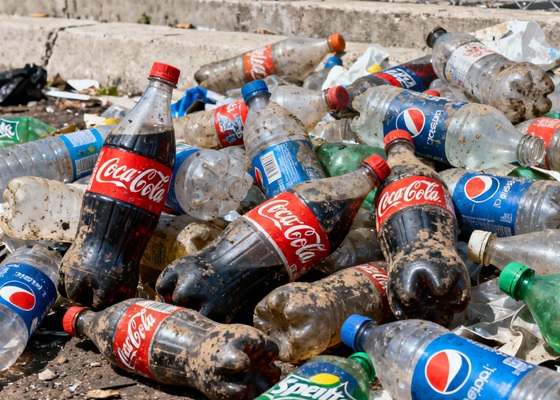
In real-world plastic recycling systems, liquid-filled waste PET bottles have always been difficult to handle. Whether it’s defective products from beverage manufacturers, expired drinks returned by supermarkets, or partially full PET bottles collected by recyclers, these bottles create major problems for the PET bottle recycling process.
Traditionally, workers had to manually open each cap and pour out the remaining liquid. This method is slow, messy, and causes splashing and odor issues. More importantly, labor costs are high and the processing capacity is very limited.
So, how should this type of plastic bottles recycling be handled?
More factories and recycling centers are now choosing smarter and more automated solutions. The key step is using a PET bottle compactor to complete the dewatering of PET bottles and fully automate the liquid-removal process.
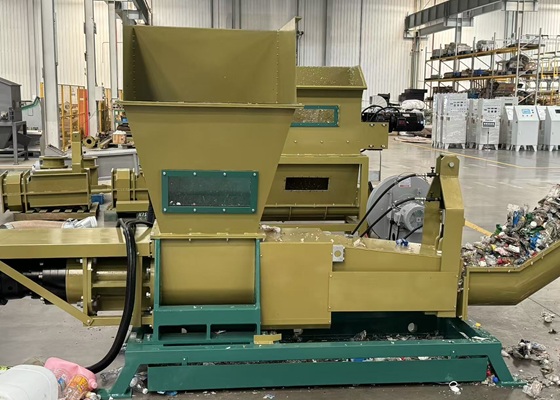
Liquid-filled PET bottles can be fed directly into the machine, where the plastic dewatering machine uses a high-pressure screw to squeeze, dewater, and compact them:
• Dewatering of PET bottles: automatic separation of bottles and liquid
• Automatic liquid discharge: remaining liquids drain into a stainless-steel collection tray
• 10:1 PET bottle compaction: reduces volume and cuts transportation and storage costs
During screw extrusion, the bottles are continuously compressed, forcing out the liquid under high pressure. The extracted liquid flows through the bottom of the dewatering chamber and collects in the tray, where it can be drained through a pipe to the designated area. The entire plastic bottles recycling process is clean, continuous, and requires no manual handling.
Efficient Dewatering Is the Key: 90% Liquid Removal for Cleaner Bottle Briquettes
Compared with traditional shredding or manual pouring, the GreenMax PET bottle compactor (Poseidon series) delivers stable, high-efficiency dewatering with zero contamination to the surrounding area:
1. Continuous screw pressing + upward-angled discharge chute → fully drains residual liquid from bottles
2. Collection tray + drainage outlet → centralized liquid collection with no overflow
3. Drier PET material → easier downstream washing and lower energy consumption
4. Reduced waste-liquid contamination → better environmental compliance
For large volumes of liquid-filled bottles, this automated dewatering of PET bottles method is far more efficient than manual handling. Notably, GreenMax has helped PepsiCo’s Thailand facility, Nestlé in the United States, and others successfully implement this plastic bottles recycling solution with excellent results.
Boosting Value by Pairing With a Plastic Baler
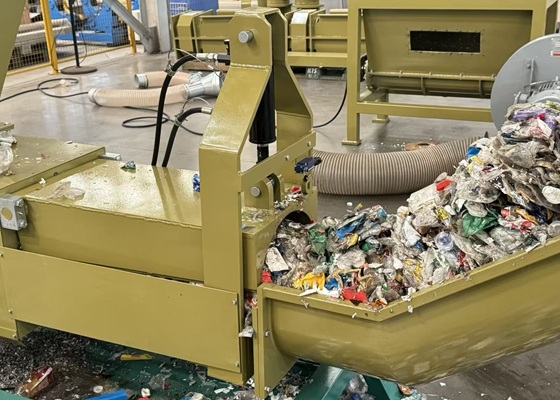
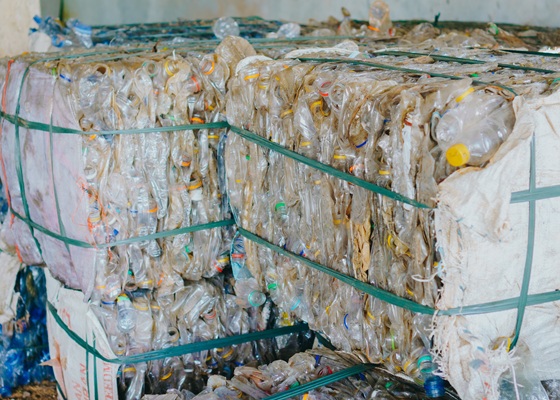
A PET bottle compactor not only handles dewatering and material separation—it can also be directly connected to a plastic baler to compress the drained PET bottles into dense, uniform briquettes.
These briquettes have higher density and stronger market acceptance, and recyclers typically buy and sell PET in this briquetted form. With a GreenMax baler, the compacted blocks can reach 300–500 kg each, significantly improving transport efficiency and reducing logistics costs.
For the long-standing challenge of handling liquid-filled PET bottles, a PET bottle compactor is a proven solution for plastic bottles recycling. By automating the dewatering of PET bottles, separation, and compaction, it greatly increases processing efficiency, reduces labor costs, and enhances the value of recycled PET material.
If you aim to build a more automated, cleaner, and more efficient PET bottles recycling system, this type of equipment will be an essential component.